For most of my years in the US, and growing up in the UK, we had our own trash can and later recycling bin, which we dragged to the curb once a week for emptying. In 1993, I moved to the US apartments I just moved back to, and that was the first place I lived that had common trash skips (two for 46 units). In London we had rubbish bins, recycle bins, and a compost bin shared by all three flats, but they were right outside the front door, so pretty accessible. But here we have to take trash and recycling to bins on the edge of the village, so the act of “taking out the trash” is a lot more labor intensive. For one thing, here in France, like the UK, we have to separate glass. But here glass goes into a huge green metal box via round holes at the top, petty much ensuring that the glass will smash when it lands. That is the one part of trash duty that I dislike. Luckily the kids tend to love it so I can delegate!

Taking out the trash involves loading the car with the bucket of glass, bag or box of recycling, and plastic bag of trash and heading to the trash bins. Most people have official milk crate shaped boxes for this, but we have never bothered to go to the recycling center and pick them up. Ditto the fancy kitchen compost boxes (or the outside composters as we have our own). There are trash and recycling bins a short walk from our house and others a short walk from Andrée’s, so trash can be easily put out every night (if you have enough, or if it smells), but for glass you need to drive.

There isn’t a glass recycling bin in the village and never has been. They smell. Actually they stink of stale wine and beer and whatever was in the half empty jars and bottles smashed at the bottom. They are not emptied regularly like the trash. There’s broken glass all around them. Nobody wants one near the houses (and then there is the need for the kind of discretion that allows people to dispose of their wine and beer bottles away from their neighbors).
Glass bins are always located in an area with a lot of reclycle and trash bins with an area to park, unlike the two or three trash and recycling bins by the side of the road around the village. The closest one serving Mouzieys and Panens (which is a separate village, albeit tiny) is just beyond the sign that says you have left the village, after the houses end. To get to this set of bins you turn onto a little slip-road behind a high but well cropped hedge, which totally hides them from the road.

The other glass bin is at the bottom of the hill, almost in Les Cabannes, serving that village and the houses between it and Mouzieys. I tend to drop off everything there, though, because it is on the way to Cordes. It has an amazing view of Cordes, looking up from almost underneath it separated only by Les Cabannes, the road, and the school on the other side of the rise. Both of these locations has a great view, with the bins on the way to Panens being the winner. The hills and fields roll away in all kinds of geometric shapes, with unruly hedges dividing fields and random farm houses centering them. It is more stunning in summer, but always an added bonus of taking the trash out.

The picture to the left is the regular recycling and trash cans just beyond Andrée’s house, two of each. The trees behind them are wild plums, and in late summer you have to squelch through fallen plums to get to the bins. I love hedgerow plums more than any others (well, it’s a tie with mirabelles in a good year), but it feels odd to pick them right next to the trash — especially in particularly hot weather when the smell is too much to encourage loitering (hence their location away from the houses). Luckily, every other hedgerow is full of plums, too..

Living with less trash
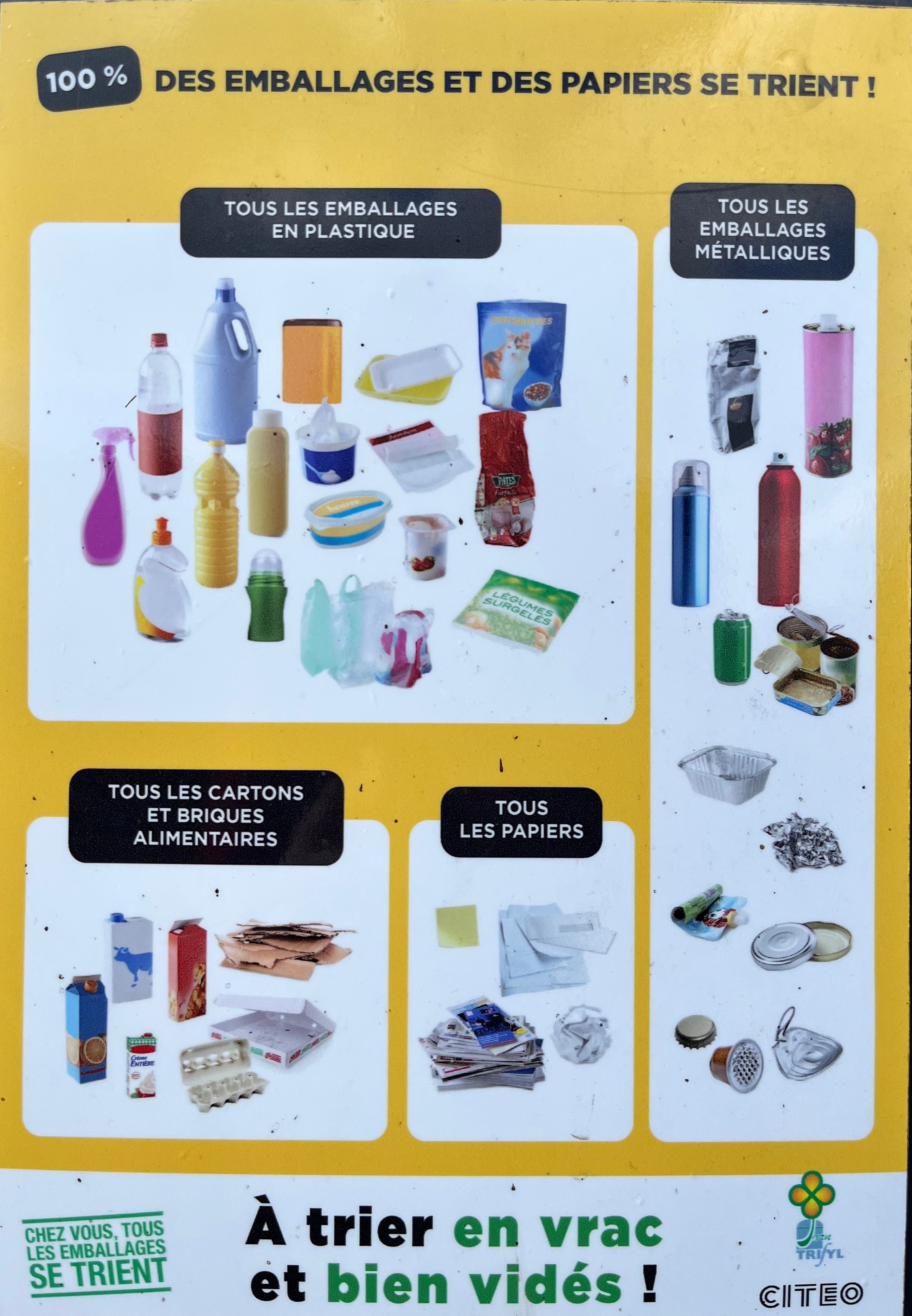
On the whole we don’t generate much “trash.” And most of what we produce can be recycled. Unlike anywhere else I have lived, the municipality handles its own recycling so they tell us to put everything out and let them deal with it, as you see on the poster to the left. The cynic in me is sure some goes to the landfill, but the poster shows all of the things they tell us to put out and promises that 100% of it is sorted at least. I still can’t get used to recycling food cartons and boxes with food still on them, though. And when Walter is in the US he can’t get used to not doing that, so I am constantly fishing things out of the recycle bin, especially plastics.
Even the hypermarket E.Leclerc (Leclerc to those who shop there) presents most of its vegetables in huge bins for customers to help themselves and put into their basket unbagged (winter squash, lettuce, bunches of bananas) or into the paper bags they provide or we bring with us; nothing is sitting on styrofoam trays shrink-wrapped or sealed into bags. So most of the “waste” is recyclable cans, bottles and glass jars, cardboard boxes, and paper bags (which can be reused and then added to the compost, so technically not waste anyway). In winter, the stoves produce wood ash, which also goes into to compost or on the garden directly. In summer there is more compost because we eat more fruit and summer vegetables — and because sadly we let more things pass their prime. We also produce a lot of left-over bread, half a loaf here or there that was solid before it could be eaten as toast. Luckily, one of our neighbors is happy to take that away, along with other food scraps, for the chickens. That leaves real trash, which sadly now includes cat litter (plant-based and biodegradable, in the end).
This post is dedicated to a middle school English teacher, Mrs Lenaghan, who taught me to see everything through the eyes of a writer. She challenged her students to write about things we take for granted. The first assignment: trash.

