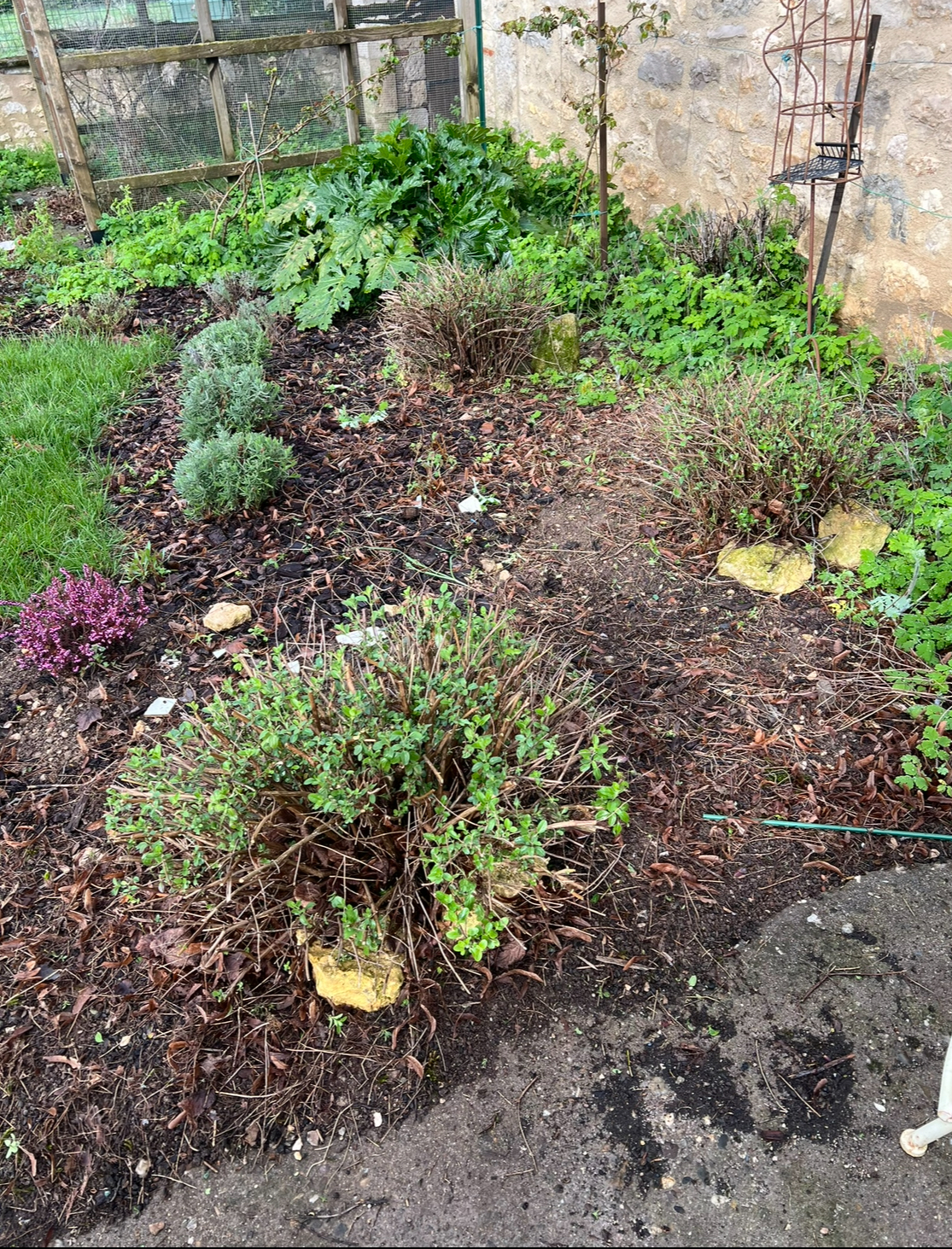


I have been itching to prune this mess for at least a week. These Salvia microphylla bushes (aka baby sage or Graham’s sage) get really scraggly in summer, but they flower almost constantly and they are very forgiving in the hotest months, not surprising as they are mostly seen in Arizona and mountain areas of Mexico according to Wikipedia. I find that if the flowers thin out, a good dose of water transforms them and within a few days they are covered with flowers again.

They didn’t get pruned last year because of my schedule and that of our garden guru Christine. But the year before she spent a fall day tidying up after I had already done my version of the end of summer prune. She took my gently trimmed bobs and made them into crew cuts. And the plants had grown to at least four times the size by the end of the following summer. Clearly serious pruning is essential. Even leggy, I still love them almost as much as the many varieties of bees they attract love them.

I had a vision for the front, which was just weeds and thigh-high thistles with roots as deep and no grass when I started. I pulled out wheelbarrows of weeds that first year and seeded a lawn. The baby sage bushes were already there, and behind them Russian sage against the wall, and two very neglected climbing roses. My vision was a shock of lavender tumbling onto a pocket of lawn and creating a wave of purple in front of the red and then more purple and finally the roses.

My friend Wendy helped me with that first row of lavender, although somehow the pots just marked “lavande” without a variety listed were much taller than I envisioned. They called themselves “true lavender” (not “lavande vraie”), which would technically be English lavender (Lavandula dentata), but I think they are actually lavandin, sometimes called “French lavender,” but according to epic gardener that would be an error. Lavandin are taller and more pungent, but they do not have “toothed” leaves like “true” French lavender. More on lavender [later], but hopefully this year my vision will emerge.

The front gardens are definitely bee gardens. They may be waiting for the lavender, but today the big clump of snowdrops was abuzz with honey bees (hopefully from my neighbor’s hives) and a lovely, if sluggish, giant Western / European honey bee. The bees are thick in the lavender all summer, and when the linden flowers the whole courtyard buzzes (see post).
We are having a warmer snap (see the “Farmer’s Almanac” to track our weather), so I started the pruning yesterday with an attempt at the bamboo by the covered patio that, like all bamboo, is out of control. It serves as a wonderful weather break behind the patio, but needs to be hacked away to stop it totally blocking the view from the studios. That got me started and I ended the day today carrying armfuls of silver Russian sage stems almost as tall as me, and multiple armfuls of baby sage around to “the pile.” And I smelt most wonderfully of sage.

Pruning tips
The other pruning I achieved yesterday was three huge white hydrangea in our courtyard (probably Annabelle variety, a smooth hydrangea — H. arborescens]. The Old Farmer’s Almanac “strongly recommends” pruning smooth hydrangeas in late winter/early spring, and that is sufficient for me. They add a lovely focal point to the end of the courtyard, whether pure white flowers starting in June, late season magical shift to green flowers, or faded paper brown in winter. Like the sage, pruning of hydrangea needs to be ruthless to encourage growth, which occurs on new wood. You can’t over-prune smooth hydrangea. So here is my guide.
Step one for really large plants
Start with sharp, sterilized, secateurs (pruning shears), ideally the kind with two blades (“bypass”), not a blade and a blunt side (“anvil”) which can crush the stems. Grab an armful of branches and just cut them off down to about 6 – 12 inches (15 – 30 cm). I’ve seen this armful method suggested for harvesting lavender stems, and I tried it last year with pretty good success. A handful (like a bunch) works, too, if the plant is smaller or your hand large.
Step two, or strategy for smaller plants


Now you can see the stems and they are closer to the ground, you can start shaping. For plants that grow on new wood like Russian sage, small sage, and smooth stem hydrangea, start cutting just above the lowest leaf buds you see (as shown on the right) and cut at a slight angle away from the buds. If possible, select buds pointing in the direction you would like branches to grow. Your ideal is to avoid branches that cross each other and might rub in the wind. But plants will do as plants do, so don’t sweat this. The key is to create a nice rounded shape and open out the plant so new growth can appear.
The cut-above-a-bud rule is good for most plants, but if in doubt, Google it, or better yet, go to The Old Farmer’s Almanac, and only Google it if you can’t find an answer there!
