In memory of Claude Blanc (28 août 1954 – 1 octobre 2025)

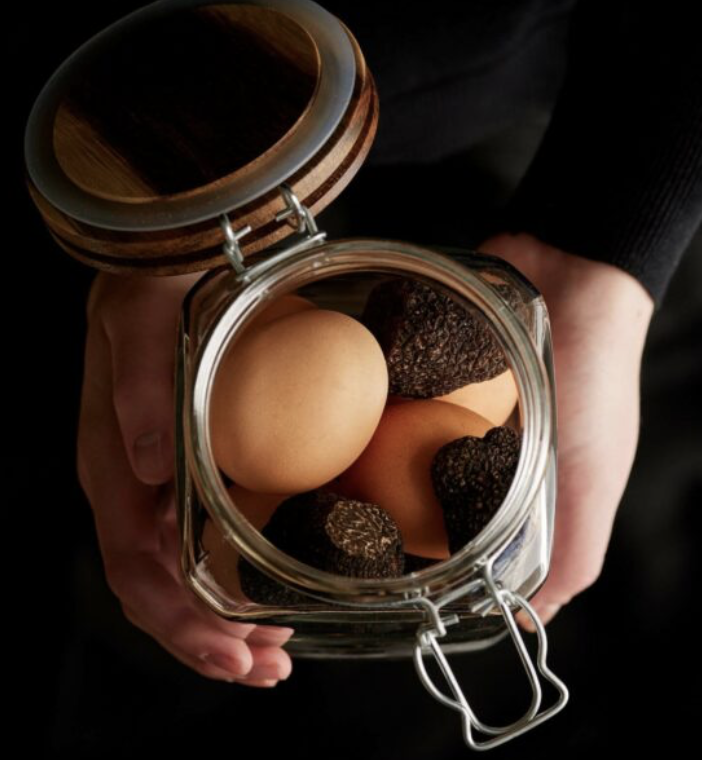
The featured image is not mine. I couldn’t take a picture of the particular jar of truffles in question, so here is one from a website describing what to do with small truffles, what Nadine, our host, had done. Take a mason jar, place a piece of cloth or paper towel at the bottom and fill with fresh eggs and small truffles, then put another piece of cloth or paper on top to absorb any moisture (change this every day), and seal. Leave for two or three days and then enjoy the most amazing scrambled or soft poached eggs, ideally with the small truffles thinly sliced or grated on top. (You can also fill a jar with arborio rice and truffles and after 3 days enjoy the most aromatic risotto.)
She placed the jar on the table. Inside were three of four truffles, each about an inch across at most and dwarfed by the half a dozen large brown eggs around which they were nestled. She opened the lid for me to smell and, of course, the smell then permeated everything. As it got dark outside, the jar sat between the three of us, its lid unlocked and the amazing oder that she and I particularly love completely masking the smell of bleach and water she had been using to mop the floor before we arrived. We had stopped by at around 4:00, after lunch/siesta when floors are mopped and visitors call, mostly just to pay our respects and offer assistance if she needed it. Of course, she has family and friends in the village, including multiple members of Claude’s family, and as the recently widowed wife of the mayor she is unlikely to need any physical help from us, but she and Claude were kind and generous to us and we appreciate that.

Our property includes a stand of oaks injected with truffle spore when they were planted, and the man we bought the house from assured us that they would produce Périgord black truffles (Tuber melanosporum) soon. A definite bonus! Knowing I adore truffles, our friends Yvon and Nadine (there are two Nadine’s in this story) bought me books about them — in French so I “had incentive to practice.” But Yvon also told me everything they said, from the impact of weather especially rain (when the rainfall is good for truffles it is bad for grapes, you can’t have everything), to how to identify when there were truffles (look for brule says the book, and truffle flies [Suillia tuberiperda] says Yvon — although I will be happy if we don’t have any of those.
The mayor of our village, Claude Blanc, who lived across the road from us (behind the hedge), knowing that the truffles had been planted also took an interest. He and his wife Nadine (the second Nadine in the story, the one with the truffles) have a large truffle farm on the edge of the village and he stressed to us that we could not sell any truffles we found (because we had to be in the syndicate to sell them at one of the designated truffle markets), although he might be able to sell some for us if we wanted to discuss that. Hold on we haven’t found any yet!

Truffle farming is quite a lot of work, but Claude stopped by to help us once he discovered that I love truffles as much as his Nadine (I wouldn’t dream of selling any we found). He was incredibly kind and generous with his time and advice and I have learned much more than is listed below, but here’s a start:
First we had to trim the trees, which were 8-10 years old. The bottom needed to be cleared of low branches so the dog could get in and dig unimpeded. Do that before the dog comes back a second time so she is happy.
In the fall, the tops needed to be trimmed to encourage lateral growth and a wider root system, because truffles grow on the roots (I took them down to about my height the first year, but I missed a year because I was in the US and now they are already trees).
In the spring, you need to inoculate with truffle skins or commercially supplied spore because truffles need to mate (I kid you not) and over time one sex tends to dominate if you don’t maintain a balance (you can’t make this stuff up – nature is amazing). We did that once last spring. Claude gave Walter a bucket of a mix of skins, spores, and vermiculite. I will need to find out where to get that for this spring’s treatment.
In spring, and also when you dig for truffles in December/January, he suggested adding a handful of the same mix, which will help to “establish a robust truffle mycorrhizal network in the soil” (TruffleGrowing.com). I’ll write more about mycorrhizal networks later I’m sure. I am rather obsessed with them at the moment as I try to learn how to steward this property and work with the plants so they can do their thing as unimpeded as possible (meanwhile, here is a Wikipedia article if you don’t know what they are — currently flagged because they want to combine it with another page, not for lack of accuracy. See also this extract from Suzanne Simard’s Ted Talk “How Do Trees Collaborate?” shared by NPR’s Ted Radio Hour).
And then you need a dog. Pigs are no good because they eat the truffles before you can stop them, and they tear up the ground. No, you need a dog trained to sniff, dig for, and not eat your truffles. A Lagotto Romagnolo[a] if you are serious about this (and have a few thousand euros lying around).

Claude and Nadine had just that dog, called Jazz. So one slightly foggy morning two years ago they brought her to the oaks. Truffle dogs work for about 45 minutes and then their sense of smell is overwhelmed and they need a nap. Jazz just jumped into the truck and laid down when she was “done.” Nadine laughed that she’s “part of a very strict union.” But in those 45 minutes she found four truffles, running helter-skelter to the back of the grove for the first one as soon as she jumped from the truck. She dug, then when she was close she backed off and lay down. Then we need the delicate digging of human hands, and when a truffle is found Jazz gets a reward of very smelly cheese. Her second visit that winter found a few more, and we were then instructed to care for the trees as described above. The next year we got more, although I was not here to see or feast on the haul (but one may have found its way to the US and been featured in a multi-dish truffle dinner for some close friends in Madison).
We were heartbroken when Claude died of a huge heart attack on October 1, 2025, not least Nadine, his wife of many decades and adventures — some of which we learned about sitting in her living room perfumed by that jar of truffles. (There is an obituary here.) Every summer my heart has been warmed to see their mutli-generational family sitting on their covered terrace enjoying lunch, dinner, and the last of the evening light, clearly enjoying each other’s company just as much and filling the air with laughter and conversation and cheerful greeting when we walked past. At the end of summer 2025 we attended his mother’s funeral. Then this Fall it was his.
When she first saw Walter after Claude’s death, Nadine told him that she would still bring Jazz to visit, but we could not dream of imposing. After the funeral she was away for weeks, so when we stopped by yesterday it was the first time I had seen her since I returned in December. We told her that the Mayor of a local village was going to stop by with the truffle dog he is training, also a Lagotto Romagnolo, and so she understood that we were genuinely there to see her not to ask for a favour. We ended up staying two and a half hours as she told us stories from their life and travels and there was much laughter. She knows the other mayor, of course, and said it is a good dog. He’s coming at the end of the week, possibly, depending on the weather.

How did we find this new truffle hunter so fast? Marie. Marie is one of the amazing women who help take care of Andrée, and she knows everyone and has a wide network of relatives. She also knows everything that is going on. One of those relatives is getting into the business of truffle hunting and his dog needs practice. And so the arrangement was made. He would come “next Thursday or Friday.” We are still waiting. This is southern France. And to be fair, it has been raining.
One of the sanglier who traverse and seem to hang out in the field behind the house has already found one or possibly two truffles based on the a ragged semi-circular hole under one of the trees. Now that the gate is firmly closed we hope this is a sign that there are more to find . . .
Update to follow.
