Fruit season is upon us. No sooner did we finish the cherries and start picking the early blackberries than I discovered that one of our fig trees is the kind that has two seasons, a short early one in June followed by the real inundation at the end of August.

First, I had figs – first figs
I already wrote about early “brebas” or “flower figs” (see July 3, 2026), in sequence as they came after the raspberries, cherries (June 2, 2026), and blackberries, so they get an honorable mention here. And you can read that post to learn more, although sadly I will miss the main crop again this year.
Then there was rhubarb

I started a rhubarb bed this year with four plants from the organic farmer (who doesn’t use machines) at the market. But this June was not a good time for any plants to be young and the plants are just hanging in with daily watering, but only just and several outer leaves have died. Once the weather broke they perked up and all of them have new shoots so, hopefully, the pie bed will generate enough for rhubarb crumble and jam in the next few years. I also planted strawberries this year. One of the plants is getting ready to give us one strawberry, and maybe we will get another once the plants no longer have heat stress, but my hopes are on next year. I love the way gardening is preparing for the future in this way. But in the meantime, I still want the fruit.
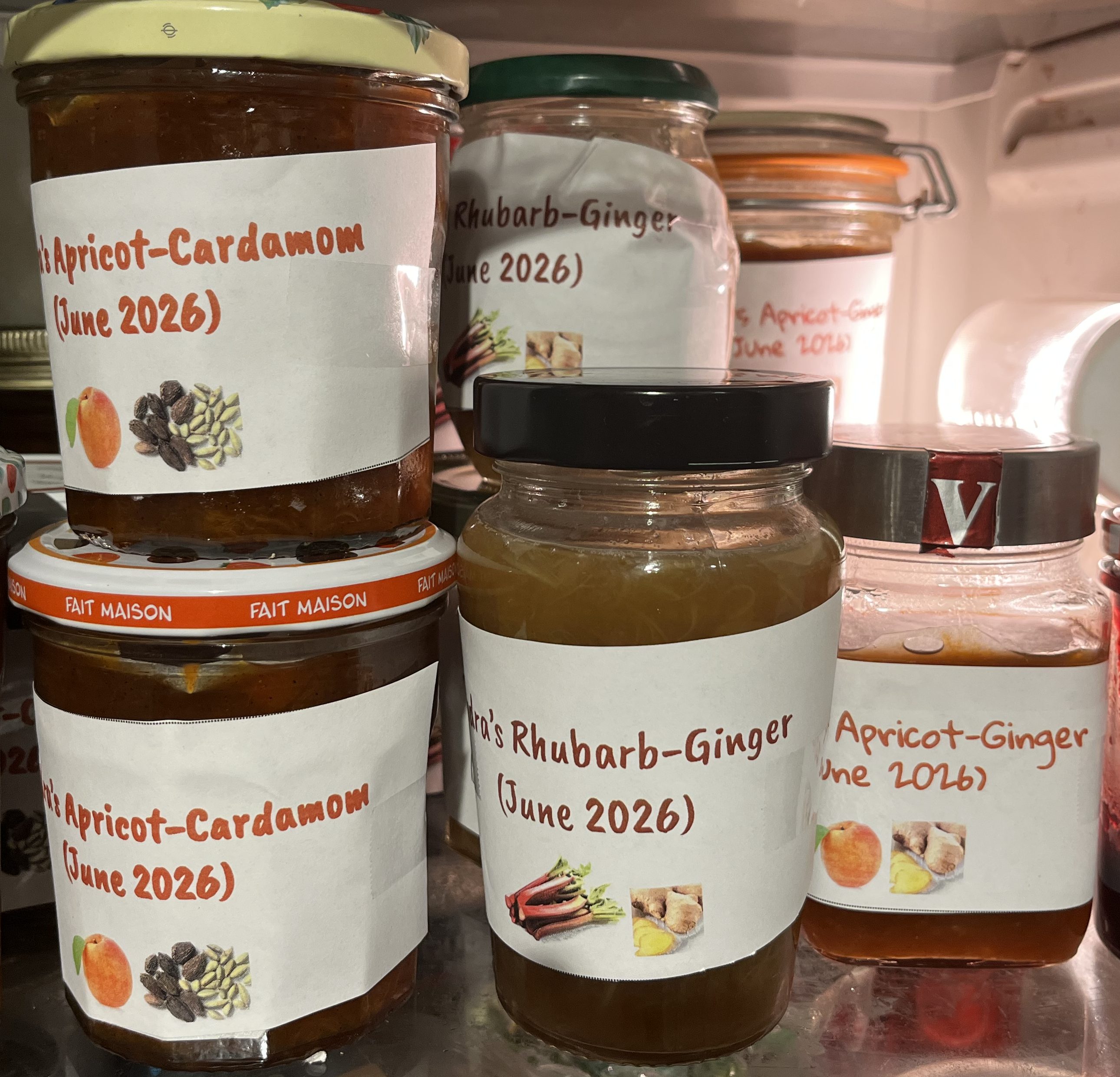
So, I went to the market and bought some of someone else’s harvest. First task: Mary Berry’s Rhubarb-Ginger jam (how could you not?), for which I have been craving since I planted my little rhubarb plants. It is such a simple recipe, you can’t really go wrong. And the jam is a wonderfully balanced mix of flavors. If you like rhubarb and ginger I highly recommend it. (I used one cup less of sugar, but more lemon juice. And I did not have any crystalized ginger, but I don’t add it if I do. Maybe one day I’ll branch out.) The overnight maceration makes all the difference. Don’t skip that step.

And then came the apricots.
We have one tree and it is still quite young, so whatever we could get to before the birds were eaten right away. Andrée’s tree is even younger than ours (the product of one of the many pits spat over the edge of her terrace), and fruits earlier but also sparsely. I don’t know whether ours will keep the lovely speckled skin in this picture as they get older, but I hope they do. Images on the internet suggest this could be a Rouge du Roussillon, and if so, the speckles will probably remain. I’m not sure why I seem obsessed with classifying all the fruit varieties, but I’m sure it is no less a control thing than was Linnaeus’ project (hopefully with less harmful ends). Whatever they are, they are very beautiful and about 30% larger than the variety I purchased at the market. The fruit eaten directly from the tree is amazing, however they look. The longer it is away from the tree, the less concentrated the sugars and taste. We stood by the tree this morning, handing each other fruit as the juice ran down our chins and up our arms. A highly recommended activity.

It was consumed by the 5 of us in one sitting.
There may not have been many in our orchard, but the market was full of them and I bought three 1kg punnets for the price of a piece of cheese. We ate some of course, and I made a country tart for dinner, carrying it still warm to Andrée’s in the car because it was too hot to walk. [Recipe below]. I love the summer fruit because you can make a tart or pie out of just about any of them. Apple we can do all year of course, but apricot is the first one for me that goes from tree or market to tart. I make clafoutis from the cherries [see June 2, 2026 for a recipe] but not cherry pie for some reason. I sometimes make cobbler from the apricots and love it if I get enough rhubarb to make my Mum’s orange-rhubarb crumble, as I will this weekend [see below for recipe].
But the next step with the apricots was jam. I bought 3kg because I wanted to experiment with three bold flavor combinations in smaller batches, but the tart reduced me to two, which was fine! I had some ginger left from the rhubarb-ginger, so that decided one of them and for the other, I had a hankering for a few jars of apricot-cardamom (which I have never had, but which sounds like a lovely combination. UPDATE: it is).
Finding recipes (avoiding AI slop)

So I did a lazy little Duck-Duck-Go search for apricot jam recipes and found a page of 18 lovely sounding options, including apricot-cardamom. Now I always source my recipes from fellow bloggers and then include a link to the recipe and the blogger’s “about me” page. In addition to being just plain polite, I think it is important to honor and build a community of bloggers, as I teach my students. There are so many fabulous, organic, earth-friendly food bloggers out there and it is a delight to find them, and so far their recipes and advice have never let me down.

I’m not sure why I didn’t do that this time. It was quite late and I was tired after a day of writing (and did I mention the heat wave?) Instead, I skimmed the random recipe, printed it out along with one for apricot- ginger from the same source, and started chopping the fruit, grating the ginger, and squeezing the lemons. I decided to substitute turbinado sugar for some of the regular sugar because I loved how it complimented the apricots and gave a slightly caramel overtone when I added it to the tart. I might not get that gorgeous golden apricot jam colour, but this experiment is about taste, so I added half a cup.
Then I reread the recipe and paused. Something seemed off. The recipe called for 2.2lb (a kilogram) of fruit and a cup (200 grams) of regular sugar. Hmm? That isn’t much sugar (far from the 1:1 ratio of yore), although there was lemon, there was no added pectin. The Mary Berry recipe only has sugar, lemon, and fruit but it is 1:1 sugar : fruit, and it includes the lemon husks in the maceration. More surprising for an online recipe, what I had printed out include none of the chattiness that food bloggers use to explain, for example, why so little sugar.
I returned to the website. Just one page wth a long list of recipes and other pages about unrelated products. No “about” page. No human voice. And the kicker, each recipe began with the same formulaic “[t]here’s nothing quite like the sweet and spicy kick of homemade [name of jam] to brighten up your morning toast or cheese board.” I’d been suckered.

But some of what was there was good, including the proportions of fruit and flavorings, so I think it was a random AI hodgepodge of information taken from other sources with a bit of hallucination (which is AI in a nutshell, isn’t it?). One thing it did say was to chop the apricots into small pieces and macerate with the sugar and lemon for at least an hour, which I was already doing and which worked well. And it proposed adding powdered cardamom part way through the boil (which was good because that is all I had).
Other recipes I found, like that on Jul’s Kitchen (which I might try next time), boil the fruit for 20 minutes with the lemon juice and the halved lemons so the peel adds pectin, and then add 300g or more of sugar. Well that ship had sailed. I was already macerating the fruit and lemon with 1 cup of sugar, so I added an extra cup of sugar (making 400g total) and a few pinches of low sugar pectin for luck [see June 13, 2026], which went against the excellent advice of The Jam Goddess (who I might have consulted if it was not 10pm). In spite of all this, the adapted random AI recipe worked and the jam is lovely. Not too sweet. Perfect texture for me (you can spoon it onto the bread and it stays where you put it, but it mixes easily into yogurt). And it is golden, as you can see in the picture above.
I like the maceration, but also adding the lemon peels. As I was trying to adapt these recipe I found the advice and FAQs offered on Kierasrecipies very helpful.
Recipes
I’m include my jam recipes with a caution because I was making it up as I went along in adaptation of the AI recipes; however, the jam turned out well — even Walter likes them!


Variations
This is my standard quick dish. I make the sweet pie with plums, figs, peaches, apples, or apricots – whatever is in the kitchen (or Prim Frais if I have time to shop). Start to finish 40-45 minutes unless your oven takes a long time to heat.
I make a savory version with the scored edge that Andrée used to call my “pastry pizza.” My recipe is liberally adapted from the versions my brother makes, which are always better.

Why commercial/frozen pastry?
On hearing my “trick,” people sometimes point out that it is really easy to make pastry yourself (this is France after all) and I totally agree. Regular pastry generally tastes better, but it also takes time. And that is the trade off. When I have time, there is an incredible recipe for a raspberry tart (Oléron Berry Tart) in Ruth Reichl’s memoir Tender at the Bone, which may be the best pastry shell and fruit tart I have ever tasted (and that is with me making it). I would love to serve that or a variation of the pastry at least, but with chilling and then freezing, you need to allow at least 4 hours just to make the pastry, then add 25 minutes to bake the shell. For the filling, there is an additional 40 minutes of baking and a 2 hour rest. In total, you need to allow over 8 hours to create this incredible tart yourself. And it is worth it (as is the book it comes from, which also includes recipes).
Of course, pastry does not need to be that complicated or time-consuming, but when I make these dishes time is generally the big issue and I include them in that spirit. You can make some pretty good almost scratch dishes if you use prepared products smartly. When I made the apricot tart I was informed that we had no desert 45 minutes before we were to sit down to dinner. In such moments, it is easy to step up if all you have to do is pull out a pack of chilled puff, slice and caramelize the fruit while the oven heats up, and arrange the pie so it can cook while you take a quick shower and dress for dinner. And it tastes pretty good.
The savory tarts are also something I generally end up pulling together just before guests arrive for a cookout, or when I learn that we have people coming for aperitif or guests arriving from the airport or train between meals. Announcement to table in under an hour. That is *not* the French way, but having appropriate food to offer guests certainly is.
Enjoy!
—ps: suggestions for improvement to these recipes always appreciated!
