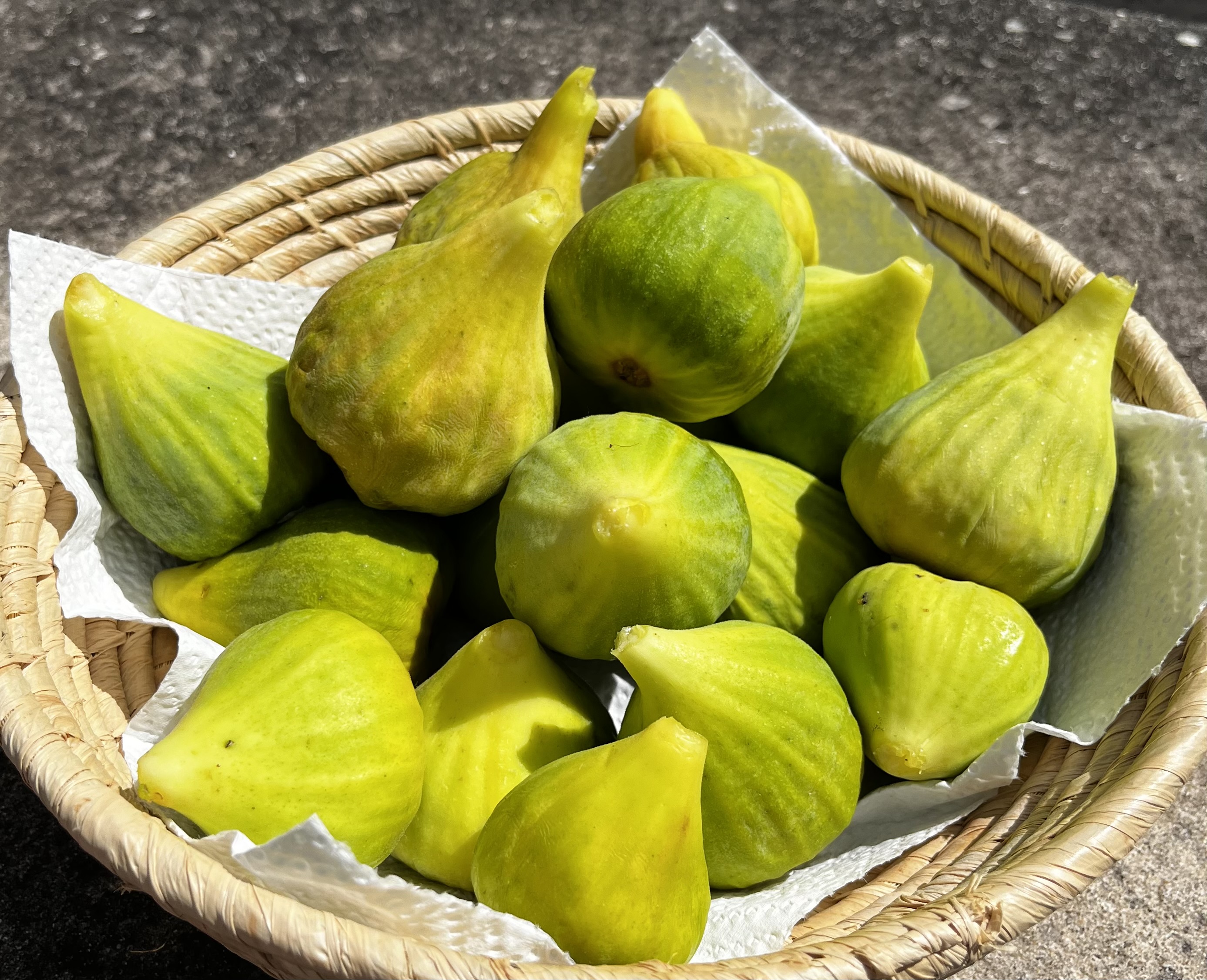

The early “brebas” or “flower figs” form on last year’s growth and ours at least do not have the density of flavor of the main crop. They ripen all-of-a-sudden and get filled with ants hardly a second later. But they are figs. And they are the first figs. And if you catch them at the perfect moment, they are perfect. Although perhaps only perfect because they are the first.
Fig varieties that produce flower figs also tend to produce figs earlier than those that don’t, so we should expect the “autumn crop” from this tree in mid-August. In this image, the big, heavy looking yellow one is a very ripe flower (brebas) fig. The others are the second crop ripening slowly on this year’s stems ready for picking in August.
As usual, I will probably miss them, which is why this early crop is a treat.
Even before we had this house, every year I posted to Facebook heartbroken images of hundreds of unripe figs making my departure even more torturous. Worsened because Walter is not a huge fan of figs (I married him anyway), so I knew most would end up on the ground even though he was still here to eat them by proxy.

Since we have lived here, Francine has kindly harvested as much as she can from our trees, which ripen before hers, much of which comes back to us as jam. I am so grateful to her for not letting it all go to waste, but this year I am hoping Walter can fill most of one of our new fruit barrels with them and we can take them to an official distiller to turn them into fig brandy (with the other barrel maybe just plums or mixed fruit — they are big barrels so we will see what we can collect). But for now I have figs.

Here’s today’s rabbit hole research project: There are so many types of figs and they ripen at different times and have a different texture, color, and flavor — although the difference is sometimes subtle to my taste. Today’s trip down the internet rabbit hole was to ask why not all types of figs have an early crop (only one of our trees does, and one of Andrée’s as well). The answer is simple: some varieties do (biferous figs); some don’t (uniferous figs). Biferous figs have an early crop in late June or early July that is actually late fruit flowers that developed the previous year on that year’s stalks, but not in time to ripen (hence their name). Once it gets warm they are ready to go, and go they do. I’m not sure whether uniferous figs produce late flowers that just fall off the tree, but I can’t find anyone saying they do.
All figs, early and late, develop in bursts, with the fruit staying the same size for a month and then growing and then hitting another growth plateau. Then after about 90 days they go from still green to ripe, just like that. The flower figs ripen even faster at the end to minimize bug infestations. Three days after I found ours, the ants and to a lesser extent the birds, had finished them off leaving a carnage of bits of skin and innards hanging from the tree and a mess of pulp and skins littering the grass below.

The main crop shows up in mid- to late- August and is much more prolific, and tasty. You also have a little more time to harvest it before it drops from the tree in a mess of sugar and bugs like the early figs. Hopefully this year they will drop in the fruit bin instead.
Here’s what I learned from the “figboss” about when to harvest: “You’ll know when a fig is ripe by determining that the neck is soft and that the white sap does not leak from the stem or neck of the fig when harvested. Figs ripen from the bottom up, so it’s important to always check the neck.” I did not know that.
Figs & wasps
There is a thing I did already know about figs: how they are pollenated. It might intrigue you, and it might put you off figs but bear with me. It is pretty cool. Unlike other fruits that are fertilized by bees visiting flowers you can see, figs are inside-out flowers (syconium), actually, the Fig Boss explains that “inside every fig is 100-400 female flowers that are attached to the internal cavity of the fig,” as this image might suggest.

The potentially icky thing is that the insect that pollenates these flowers, a tiny fig wasp (Blastophaga Psenes), does so by getting inside the syconium and laying eggs. The baby wasps exit the fig long before we eat it and the female is long dead and disintegrated into the sugar. The crunch you feel when you eat a fig is the seed, not the remains of a wasp. But technically French figs are not vegetarian. (Some US varieties are bred to be self fertilizing and not need wasp labor, so don’t despair, just look for them!)
The process starts by a female wasp entering a fig taking pollen with her. She lays her eggs in the flower and then dies. Figs produce an enzyme (ficin) that dissolves the wasp’s body, using it to feed the tree. When the eggs hatch, the wasps mate, then the males die and get absorbed by the fig just as their mothers did. The female wasps leave the flower through the same hole at the base of the fruit through which their mother entered (you can see it at the bottom of the fig in the image above), taking pollen with them. They enter new flowers the same way, lay eggs and pollenate the flower, then die, and the cycle continues. Their bodies are dissolved by the tree, and the pollenated flowers grow into figs. I admit that I tend not to think too much about this as I eat figs, checking for ants rather than dissolved wasps, but it is amazing how much insect labor goes into creating this fruit! Read about this in more detail at Peppers Home and Garden, and Fig Boss.

But what kind of figs do we have?
Interestingly, all of our figs — those with brebas and those without — are in the family Figue Blanche, which have green skins and orangey-red flowers, and are not the most prized for taste. And that is all I can say with any confidence. We have the one early blooming (biferous) fig, but the rest, while they look similar, fruit later in August so I assume they are a different variety. So, they may be a French version of the Italian Dotatto, Italy’s most common fig (known as Kadota in the US). They are certainly not the celebrated Solliès Fig, which has dark skin (and its own Appellation d’Origine Contrôlée no less!). Dotatto only produces one crop, so maybe the June fruit came from a Marseille Fig (also known as Oregon Prolific and St. Anthony Fig). But these are just internet-fueled guesses. I have no idea! And if the little wasp is not very particular about where she lays her eggs, then we probably actually have mixed variety figs unless one of them is self-fertilizing.

I actually like the fact that I have no idea. There are fig trees everywhere, along the roads in addition to in hedges and gardens. These non-orchard figs tend to be green (white figs) of some kind, while a lot of neighbors (including Francine) have varieties of dark figs in their orchards, which ripen later but are very beautiful and sweeter to my taste.
What do I know is this: everyone has figs, and everyone makes fig jam. Like plums. And it is wonderful. One day I want to make fig and lavender jam, but that will be after I retire and can be here in the Fall. For now I feast gratefully on the labor of others.
According to the blog “Life in Rural France,” figs are “a superfood,” rich in fibre, potassium, calcium, and magnesium, and a bunch of antioxidents. So they help support digestion, “heart health, bone density, and overall bodily functions [and] … protect cells from oxidative stress.” There are even claims that figs “support skin health . . . help fight inflammation and promote a healthy complexion.” Almost everything in my garden either claims health benefits or is toxic (which in small doses some claim can also be medicinal, although after my adventure with spurge [see December 29, 2025] I am not going to find out!)