Things are planted, now I need to keep them alive…

Recently my BIL’s partner showed me some beautiful and intricate sketches of how water may have been drawn from aquifers above layers of clay to feed a fountain and provide water for the palace garden in Gaillac. I said that I thought she was studying the history of palace gardens in the Tarn and she replied “you can’t have a garden without water!” Ahah! Being from England, I hadn’t thought about it like that. But yes! Here in South West France that is absolutely the case as I am learning only too well. The lovely healthy raspberries I planted in early March greeted me with brown leaves and petrified fruit on my return from Senegal. Rain had been predicted several days while I was gone, so I figured they would be okay for ten days and just asked Walter to water the seedlings, cuttings, and various plants in the courtyard (and take care of Mia). It did not rain. Lesson learned. And that lesson applies to the whole garden now. While the shrubs in front of the house [see future post] were selected because they can thrive on neglect, the rest of the garden will exist only with added water.
But first, where does our water come from?

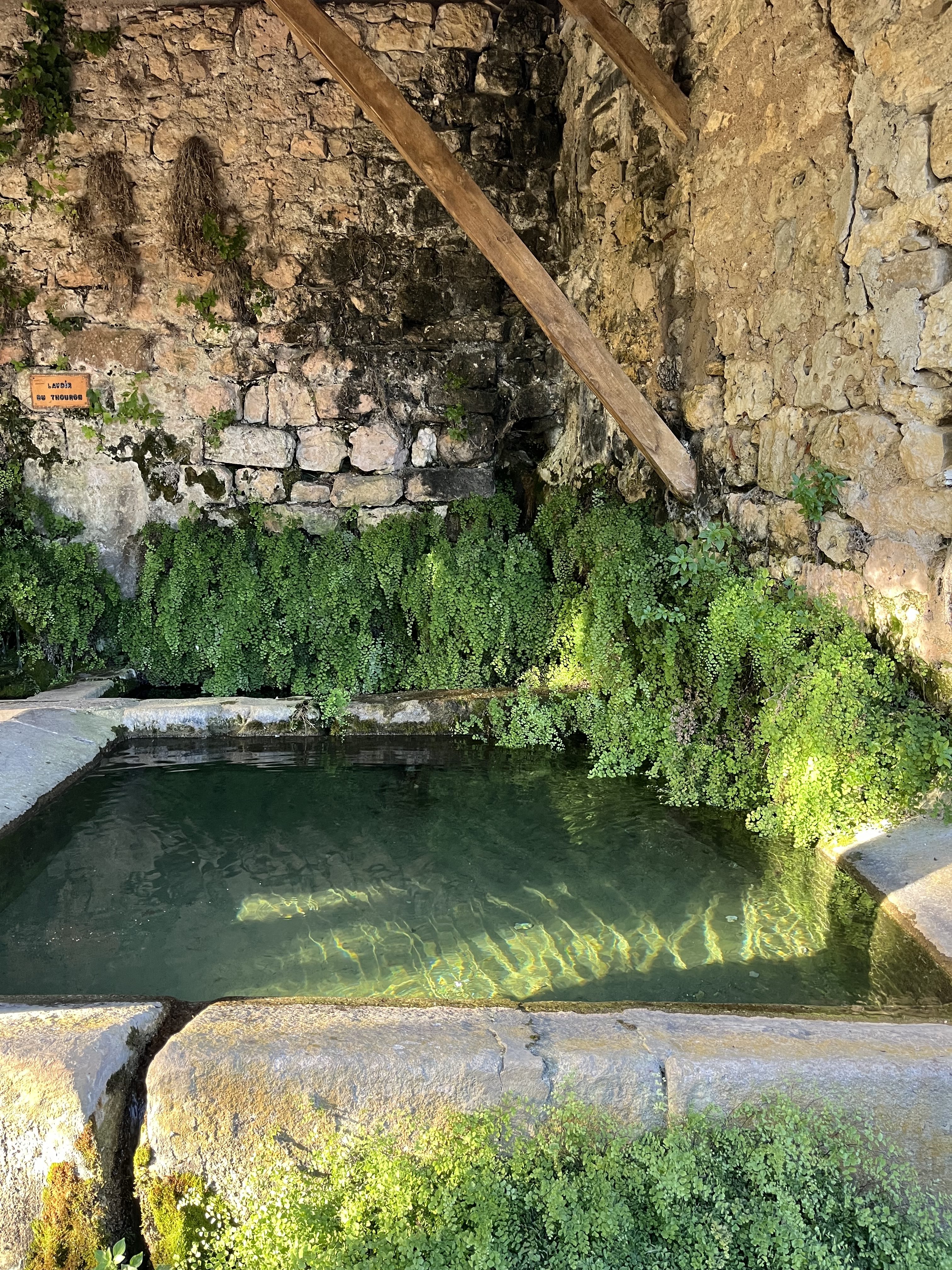
What some locals describe as a “huge lake” in the limestone below the plateau, is very likely one or more aquifers into which many of the houses have drilled artesian wells, including ours, right in front of the house. Andrée’s is attached to the wall of the house that used to be a barn. A spring (maybe) runs on the other side of her field, which feeds the Mas Lavoir (wash house) half way down the hill and eventually drains into the Cérou river in the valley (the one that flooded in February). I assume her well, the lavoir, the horse trough across the road from it, and her neighbors’ wells all draw from the same source. Andrée’s well is usually covered, but you can still see that it is a well. Ours is less picturesque with the hole just covered by two large concrete slabs. But we still use it as I’ll explain below.

Villages grow when they have adequate water to support an increasing population. You need public water for people and animals to drink, but also for laundry, agriculture and gardens, and in some cases industry. There are two public lavoirs in Mouzieys (the Mas and the Thouron) in addition to many others in villages and hamlets around the plateau. [The lavoir deserve their own post, check back later.] It could be that the many “springs” running off the plateau that feed them are all flowing from the same aquifer, in which case “a giant lake” is not a bad description.
Alternatively, they could come from smaller pockets of water that collected above layers of the clay we see down by the river. The pocket theory does explain why plants thrive in some places and not others. “Look at how big that jasmin has become in comparison to the other one” said Nadine one evening sitting on the patio at her house bathing in the jasmin scent. “That one has found the water!” We have an area in the field that stays mostly green while around it is hay, and is currently spouting wildflowers and, after two summers of not getting mowed, has also gifted us a 2 ft high chicksaw plum tree! That is the place favored by the sanglier last winter [see January 3, 2026], so I’m sure they left us the seeds freshly manured, but we assume there is a water close to the surface, too. The linden trees are right next to our well, and clearly they found water, although much further down.
Artesian Wells and aquifers

Whether you think of it as a lake or an aquifer, the water gets from it to us via artesian wells. Walter says that all the older houses in the village have artesian wells, and some still use the water from them even though we now have municipally provided water. The pressure from the aquifer pushes the water part way up the well, but we still need a pump to get it to the top, as do most other houses I think (happy to be corrected on that!). This image from the US National Ground Water Association (NGWA) website shows different kinds of aquifers and wells (their website includes more information than you might wish to know about the different kinds of aquifers and how they work — it’s fascinating. Check it out!). Mouzieys is 1,012ft above sea level, and the (man made) lake at the bottom of the hill is 600ft, about 50ft above the Cérou river, so this image does not exactly capture our situation, but it does show how the aquifers (and “perched aquifers”) work.

But are there layers of clay under the plateau? A rather scary map from the ecological ministry of the French government shows that the valleys going down from Mouzieys to Les Cabannes and Belize are at high risk for “shrinkage-swelling” of the clay layers (and damaged homes may qualify for government funds to fix them). So yes, there are clay layers underneith us!
I have to admit that as I started writing this post I got lost in a whole series of rabbit holes about surrounding geology and its impact, and was so intrigued that I actually translated some information about water supply to Cordes-sur-Ciel (see below). If that isn’t your thing or you know it already, skip the next two paragraphs to see more about my gardening adventures — the real point of this post. But I think it is absolutely fascinating. Also fascinating how much I have forgotten from my secondary school geology classes!
You can’t survive a siege without water either… (another rabbit hole)

History buffs already know that bastide and other fortified towns need a protected supply of water within the walls, and research on Cordes-Sur-Ciel across the valley from us might provide another clue about what is going on under our plateau. At the top of Cordes in the Place de la Halle is a 114 m. deep well (Le Puits de la Halle), much studied by local historians and geologists. It is carved into rock at the top but then the sides are surrounded with the same blocks of stone used for the buildings in the 13th century.
Equally interesting is the other wells (if you read French or have the patience for Google Translate, two Bulletins of the Société des Amis du Vieux Cordes from 2010 and 2011 offer a description of each of the existing wells in Cordes, continued in the next Bulletin). Worth a read for tourists to Cordes who want to see something more than the gates and fortifications, and the usual “must sees” (worth seeing though they are). Anyway, the point is that these other wells draw on aquifers at different levels under the plateau, and several draw from an aquifer that its atop a thin layer of clay between 30 and 40 m below the surface (the main well goes down to the Cérou-Aurosse water table at 100m).
So maybe we have a lake (big aquifer) and pocket aquifers supported by clay layers.
Okay, I need to water the garden!
Finally. The reason I did all this research

Our house is ingeniously set up so we can use water from our artesian well to water all of the gardens. Previous owner(s) put in a faucet/tap next to the kitchen garden, another by the side of the barn, and a third by the back of the covered patio so we can water the olives and, now, the roses and lavender as well. There is also a stone sink and tap in the side patio. All draw from the artesian well and, thanks to the pump, maintain good pressure, but of course they need hoses to deliver the water to its destination.
After watching me haul watering cans down to the bottom plot to water the raspberries, Walter bought a super long hose that we have run along the wall and can use to water all three orchard beds by hand or with a spinner. I was also watering the kitchen garden by hand until I found a second spinner that casts big arcs of water well distributed over all of the plants and landing like gentle rain. And I used the same for the bushes in front of the house. One garden per night. Hand watering takes a long time and doesn’t really give the soaking the plants need, but sending water into the air before it hits the plants is not very efficient when water is limited and the air is dry. And it is hard to know how much water each plant has received, especially with the plastic mulch (see Gardenista’s list of pros and cons of landscape fabric).
Passive Watering systems

We inherited a passive watering system of drip hoses in the olive grove, it is just long plastic tubes suspended about a foot from the ground with red emitters (I call them “drippers”) like those in the picture stuck into the hose on each side of each olive tree close to the root line. Attach a regular hose to the end and it drips or sends a little fountain of water as needed. It is old and a lot of the drippers were blocked, but I discovered they can be replaced — pull out the old one, push in a new one. There are lots of fancy drip irrigation systems that you can spend a fortune on, but I got a bag of 200 drippers from the hardware store in Les Cabannes for a few euros and a huge roll of rather stiff plastic irrigation hose, made holes where I wanted them with a screwdriver, and pushed in the drippers. That works just fine, especially with our super-stony soil into which pushing anything is almost impossible.

The plan was to make a loop around the pie garden with strategically placed drippers so I can just get water to the roots. While rhubarb, raspberries, red currents, myrtles, and artichokes have different hydration needs once the plants are established, young ones in chalky soil seem happy with regular water and in hot, dry days the top 1-2 inches of soil/stones dries out pretty fast while the subsoil is far from soggy. Because the hose sits on or just above the ground I can easily control individual drippers, turning them to a little fountain, a drip, or off as hydration needs change. I love these!

Meanwhile, I had procrastinated on installing the same system in the vegetable garden (taming and securing the coiled pipe and pushing in all those drippers takes a long time and is quite frustrating). The plants seem to like the weed mesh and that does help to retain moisture and shade the soil, although if I had planned ahead I would have put down the hoses before I put down the mesh. Lesson learned! However, as we headed into a heatwave like those we don’t usually expect until August, drastic measures were called for. A week with afternoon temperatures hovering around the low 100s F (40ºC) with days at 104 F in the shade, would be too much of a challenge for relatively young plantings, even though the nights will cool to the mid-60sF/19-20ºC. The temperature doesn’t really drop until dawn, but then you have a few tolerable hours and both the kitchen garden and the pie garden are at least partially in shade until 11:30am, so with an early start for a few days I was able to set up a passive watering system in both gardens.

It worked for one day, but then the well gave out after less than an hour.
Usually, the artesian well has enough water for at least three hours of watering and then needs 6-8 hours to refill, so everything can get a good soaking every other day or morning and evening at a push. But in the hottest August days the water level in the well is lower after refilling, and we only get enough water for an hour or so. We seem to be there early this year! I thought that if this is a smallish aquifer and the summer visitors had been filling their pools from it we might see more stability in a few days, hence my dive into the rabbit-hole on aquifers. I don’t think that is the explanation. I’m sure the heatwave will end with a few big storms and the water level will go back up, but for now, no water.
When the well runs dry . . .
When the municipal water was installed into the house someone did something brilliant. The water comes up to the house in a pipe from the road in front (where there is also a fire hydrant), and runs under the orchard to the front of the house, entering in the same place as the well water did. Perhaps this is true for a lot of houses, but what they did is install the pipes next to each other so we can switch the water supply to the house, using well water or municipal water as we wish. The well pipe was set up to feed the garden taps and the house, so the pump is generally set to just send well water to the garden and municipal water to the house. But here’s the brilliance. When the well runs dry we can pull the lever, turn off the pump from the well, and send municipal water to the garden as well as the house.
I may have misrepresented the mechanics there, but the result is I can water the garden! Thank you technology! We do have to pay for the municipal water of course, but it is cheaper than replacing all the plants.
Further reading for those fascinated by any of this
Wells in Cordes-sur-Ciel
- Information about the 114m well in Cordes (in French): https://savc.fr/non-classe/le-puits-de-la-halle-cordes-sur-ciel/
- Other wells in Cordes (in French): https://savc.fr/wp-content/uploads/2019/05/Bulletin_N_06-LA-MA%C3%8ETRISE-DE-L%E2%80%99EAU-%C3%A0-CORDES-1.pdf
- Here’s the video about the well in Cordes (Le Puits del Halle): https://savc.fr/non-classe/le-puits-de-la-halle-cordes-sur-ciel/
Geological information
Clay layers under the Mouzieys plateau:
- Ministère de la Transition Ecologique. Risques Retrait-Gonflement à Cordes-sur-Ciel (81170) https://fonds-prevention-argile.beta.gouv.fr/rga/commune/cordes-sur-ciel-81069
Artesianal wells explained:
- Helmenstine, Anne. “Science Notes: Artesian Wells.” The United States National Ground Water Association (NGWA) website. June 10, 2024 (updated on March 4, 2025). https://sciencenotes.org/artesian-well-what-it-is-and-how-it-works/
Weed mesh:
- The folks at Gardenista have a thoughtful entry on pros and cons of landscape fabric and I think I might try landscaping paper when I replace the plastic (if I can find recycled paper and organic paper like the kind they recommend), or just make use of all that cardboard as initially planned . . .
