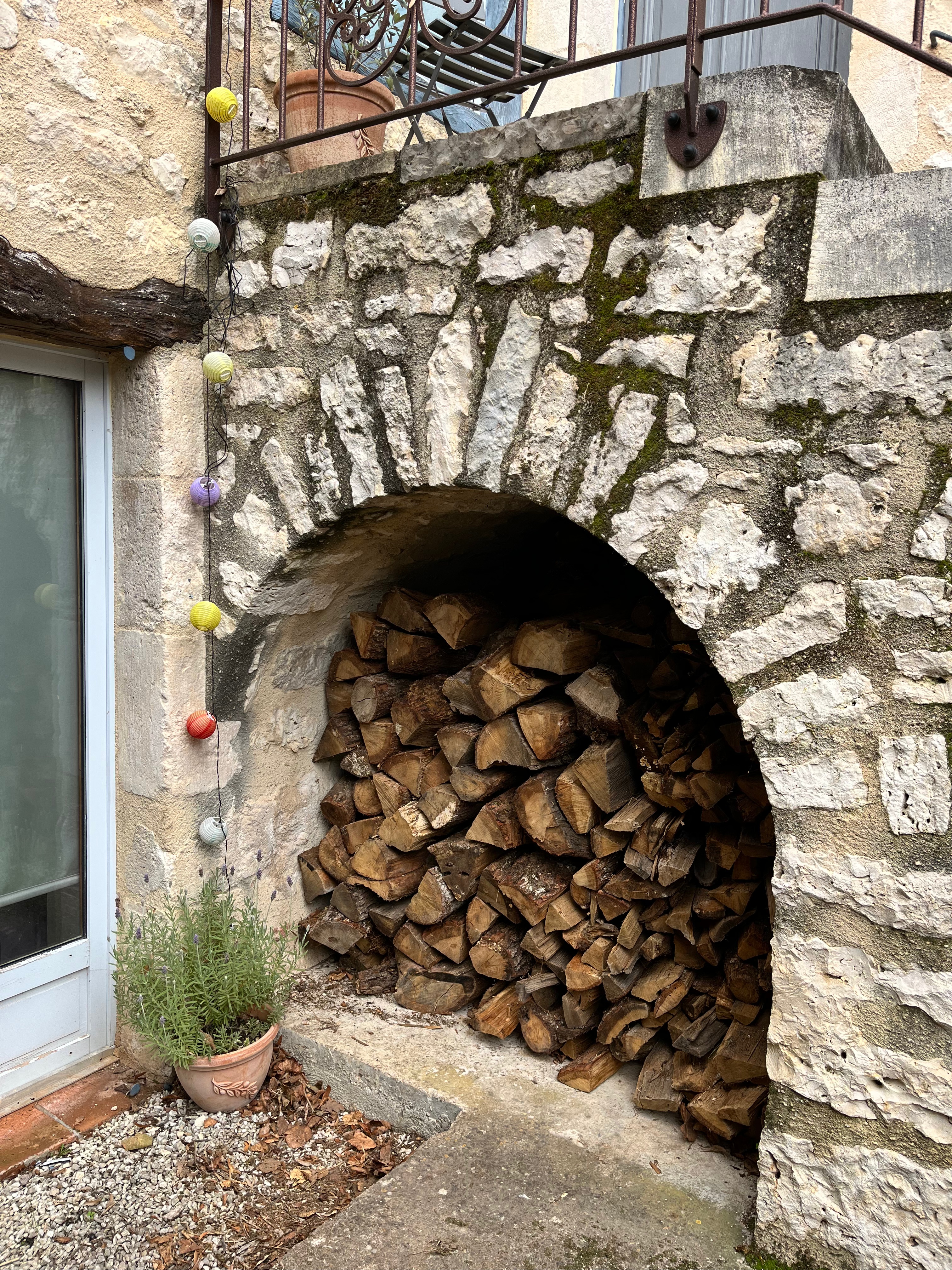

It takes a lot of wood to heat our house, and a lot more to keep the three stoves burning here and at André’s and the house across the road from her when there are people staying there, as there were at Christmas. Wood here is ordered by steres (one cubic meter), which for my American readers, is little under a third of a cord (which comes in at 128 cubic feet, or 3.6246 cubic meters). Andrée was almost out of wood, so we ordered three steres for her and one for us, just to top off the front of the pile at our house. Our new guy delivers the wood as close to the pile as possible, which is lovely because a few years ago I remember having to take it from the front of Andrée’s house to the back (downhill through an increasingly muddy field to be stacked under her terrace.

With not much walking, Walter, Boo, and I made short work of stacking wood at both houses, speeded up even more when Françoise joined us. While our wood is stacked close to our house and we can easily replenish the pile by the stove, the easiest way to get wood to Andrée’s pile by the stove is to stand by the pile and throw logs to someone on the terrace (no, I do not have a picture of that).

Work was speeded further because we were stacking in the freezing fog (you can see it in front of the olive tree in the picture to the right).
It was actually even colder today, and on the way to the gym a small wild boar (sanglier) came hurtling toward us from across a frozen field, dark brown against the frosted grass. I only saw one (I am used to “when you see a deer look for the other one”), and when I slowed down it did, too, so there was no collision. A friend’s car was totaled when his wife was hit by a full sized sanglier a few weeks ago so I didn’t want to take any chances, even with a small one. If you hit them head on it is said that they bounce up onto and through the windshield, and the thought of an 80 – 200lb boar smashing on to our laps seemed a very good reason to slow down. No road kill for us, thankfully. But I have been hearing gunshots whenever I go outside recently. Followed by barking dogs, which suggests success although I know nothing about boar hunting. (As far as I understand, hunting season is basically whenever you like, especially for farmers who suffer a lot of damage from the increasing numbers of wild boar.) The man we bought this house from was a hunter, and there were meat hooks in the attic when we looked at the house before he moved out — a perfect place to cure the spoils of the hunt out of the way but warm and dry.

There are sanglier in the big field behind the house, you can see their trails and resting spots just as I am used to seeing from deer in the US. They also dug where there were truffles last year, and from the shape of the dig I am guessing they got one or two. That’s the trouble with using pigs to find truffles I am told, unlike trained dogs, they eat what they find. Can’t say I blame them!

A couple of years ago someone sent us a newspaper story about a herd of wild boar running around Cordes-sur-Ciel (the video is quite disturbing), but the ones we have seen as we drive off the plateau, mostly on the road to Laguépie and Les Cabannes, have been solitary. And as only one tree was dug around I assume that might have been a solitary one, too. Still, we are keeping the gate to the back field firmly closed now, in the hope that we won’t find one wandering in the front courtyard as we go out to admire the moon!
The appearance of wild boar around urban areas is, like the foxes in London and coyote in he US, a result of the way we urbanized and conduct ourselves in our urban areas. Here’s more if you are interested in sangliers and how France is dealing with them (from an interview with ecologist Raphaël Mathevet, coauthor with Roméo Bondon of Sangliers, Géographies d’un Animal Politique,, Actes Sud, coll. “Mondes Sauvages”, Oct. 2022, in which each chapter begins with the animal’s perspective—the interview also talks about the importance of “perspectivism”— something that I find increasingly fascinating and as I work to live with the land and animals here).