I’m back from a 12 day trip to Senegal and promise a separate blog thread with pictures and travel stories as soon as I get some control over the work I didn’t do while I was away. That includes a dissertation (reread and defended successfully), setting up for an honors society induction (Pi Epsilon Pi, for students in writing studies) when I get back to the States later this month, finalizing Undergraduate Course Embedded Writing Fellows for our First Year seminars — still need three more. (Next up Writing Across the Curriculum Fellows at the end of the month).

And the big thing: I need to finish a draft of an article on my research with the Partnership for University Plagiarism Prevention (PUPP) to be presented at a PUP-EII symposium in Coventry in May — the reason I applied for a sabbatical this semester. The article was fighting me until I realized that it needed to change direction; now it is on track, but late. I am excited to get back to research and intellectual challenges again, but I write so slowly! At least I have been sitting outside, with Mia as my muse. She has always loved to sit on a chair next to me as I work and I am delighted that she is now joining me outside. She is getting so much stimulation that she seems like a young cat again. She even caught a mouse inside the house while I was away!

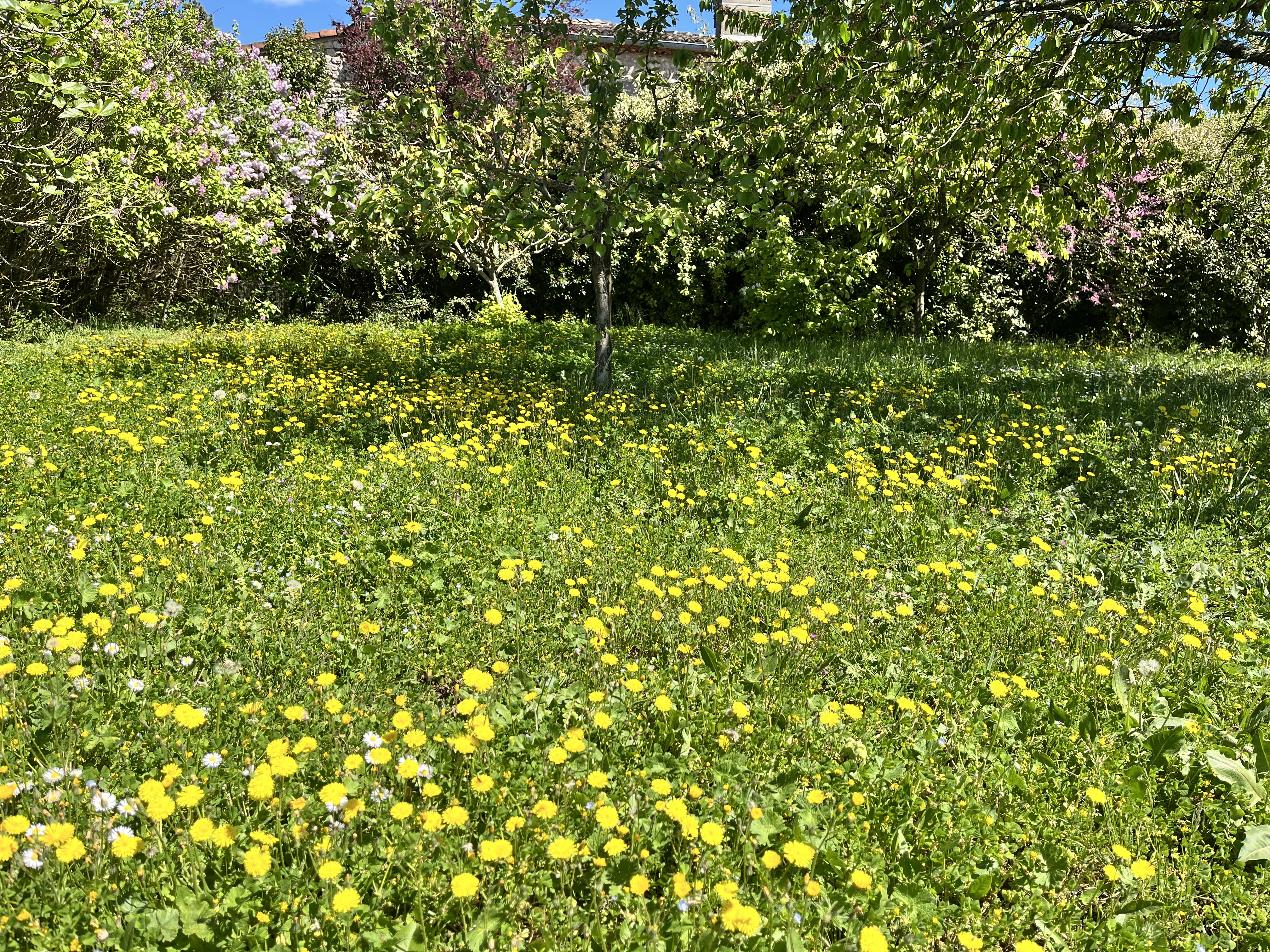
Oh, and then there’s mowing. Two weeks doth a meadow make. I took Mildred and the strimmer out for a spin each night when my brain was mush, and Walter heroically stepped in when he saw how stressed the paper was making me. So all is mowed, including the evolving garden/seating area in the orchard (see March 31, 2026). Some strimming still to do around the oaks and the olives, though, and it will need to be done again in ten days at most, but we caught it before the grass was too long to cut. And tonight I walked outside barefoot, although sadly that was only safe because the bees that were in the clover and daisies have now been forced to find new places to feed. (I’d feel guilty if the whole place wasn’t dripping with flowers.) I just read about The Ultimate Dandelion Cookbook: 148 recipes for dandelion leaves, flowers, buds, stems, & roots, by Kristina Seleshanko, on a foraging site, and now I regret that I did not have time to gather all those dandelion flowers to make fritters or syrup, but the thing about dandelions is that they will come back!
While I was mowing the olive grove I noticed the first piece of exciting news:

1. The olives that lost all their leaves are growing new ones
Just little green buds at this point and certainly not on every branch, but the trees are not dead and will, I assume, come back.
2. The Apple trees with Canker are covered in blossom

The canker will eventually gird them I assume, but for this year they are fighting back. I have no idea what the extent of the infection will do to the fruit, but it looks as if there will be some. And apple blossom is probably my favorite. Although the quince blossom is lovely as well (see below).
3. The whole garden is a mass of flowers and leaves.
The lilacs need no help, filling the hedge between the front courtyard and the orchard with an overpowering scent that you can smell throughout the orchard. There are red buds with more buds than I have ever seen, and saucer-sized peonies on the peony tree behind the gate that smell amazing. And irises at Andrée’s house.

The wisteria are also flowering in a curtain along the edge of the covered patio. I’d like there to be more in the future but they seem to be competing with the golden kiwi for the corner closest to the grill so I may need to tie them. I love wisteria and really can’t get enough. Yesterday we stopped by the house where our friends grew up and I took endless pictures of their wisteria trellis. There is a tribute to the gardner-mindset. I’m not sure how old they are, or when the trellis supporting them was build, but many years after planting, and after the death of the planter, the flowers are a beautiful cascade that I could look at all day.

This makes me think of the Lindens, which are covered in tiny leaves, still small and tender enough to eat alone or in salads with a light, slightly acidic taste. There are tiny Linden trees sprouting everywhere and I am tempted to encourage one to grow near the gate where the sixth tree used to be before it was removed (three owners ago?) to make way for the wider gate. There is a hole in the canopy that makes me sad, and restoring the missing tree feels very appropriate as they have offered so many offspring to select from. Lindens can live more than 300 years I’m told, and ours are visible in a picture of the house from 1900, so they are certainly maturing, but they might live to see offspring reach a respectable size, even though we probably won’t. But like the wisteria trellis, that is the thing about a garden: you are always planting for the future.
Both the future and the past are on my mind today because,
And today is the third anniversary of our purchasing this house. Happy new house day!
We celebrated with our own fresh asparagus lightly sautéed in olive oil. Asparagus can grow up to an inch an hour I am told, and we have a good crop every day. What a great house to come home to.


It is hard to see the asparagus in the grass and weeds. Next year I’ll get that area under control in advance and put down a layer of straw so we can see them. The kitchen garden is the last area that I need to tackle. Hopefully within the next few weeks before I head to the States for graduation and related activities.


The iris is in front of Andrée’s house, but I hope to have my own next year. She has a lot of these and bearded irises and they look lovely against all the pinks and whites of this part of spring. This stunning red bud is on our property as is the lilac.


I have never seen a peony tree before, only bushes. It is impressive. Walter sent me pictures last year but seeing and (especially) smelling it in person is a whole other experience. I just made it back in time, too, because they are already fading and the first ones have dropped their petals. Spring waits for nobody.
I took so many pictures, but this one also makes me happy. The whole, gnarly, row of grape bushes is covered with these new, delicate leaves and flowers that look like tiny bunches of grapes — and will become grapes later this summer. Christine was right about the need for severe pruning. The longer branches we didn’t prune so they could grow over the arbor are already leafy and beginning to make enough shade to sit under. There are three kinds of grapes, although I can’t see the difference yet.


The final two images are quince flowers. We have a full tree and a young one next to it that probably seeded itself. It is interesting that they are flowering now, so long after the other fruit trees but at the same time as the apples given the argument that what is referred to in myth and legend as apples was really quince (the Trees of Antiquity website has more to say on that — and some lovely trees for sale). Because quince flowers so late, I assumed we would not have many, but the amount of flowers seem to promise a good harvest — you can’t have too many quince if you are willing to cook them. Sadly, I will probably have left before they fruit.

The first time I saw quince (when I was here on sabbatical in Fall 2017), Andrée presented me with a bucket full and a cleaver and said “you can make quince jam” then went to a concert with a friend. Challenge accepted. Luckily the internet was rich with recipes, and instructions for how to cut them (they were hard enough to need the cleaver. I gather some varieties are softer). That time it worked and I caught the jam just as the fruit changed colour and made perfect jam (to my mind anyway). The second time, fresh from my former triumph, I turned away for just a few minutes at the wrong moment and the overcooked fruit turned into a mess that was too solid to even cut into slabs of coing paste (membrillo). Lesson learned. Multitasking does not work.
This image come from the quince jam recipe on the “Simply Recipes” website, it is actually of two jars of quince jelly, but it captures the beautiful colour that signals the jam is ready. This recipe is all you need (and a few pound of perfectly ripe quince — you can tell they are ripe by pressing gently at the flower end. They will still be hard but they will smell amazing when you press). I don’t grate the quince, but I can see that it would reduce the cooking time. The same website also includes the more complicated process for making quince jelly, which I may try if I am here when they are ripe. I’ll probably give quince their own post one of these days when I get chance to try making jelly.
All this talk about jam is too much. Time to go make some toast! I think I’ll ladle some of my cousin’s lovely fig & violet jam on it to get me ready for summer.
