Tending the Orchard, part 2
I was feeling good after my work on the orchard. Thinking “perhaps I can do this!” But it is good to be reminded that it is never that easy! Beautiful spring flowers, delightful birdsong, industrious bees, and the promise of fruit to come is balanced by plants that froze in the unseasonably cold spell or got wind damage in the gales that followed; continuing signs of box blight in the front hedge, olive trees with leaf drop, a yellowing and dying cyprus hedge, and now a tragedy in the orchard.
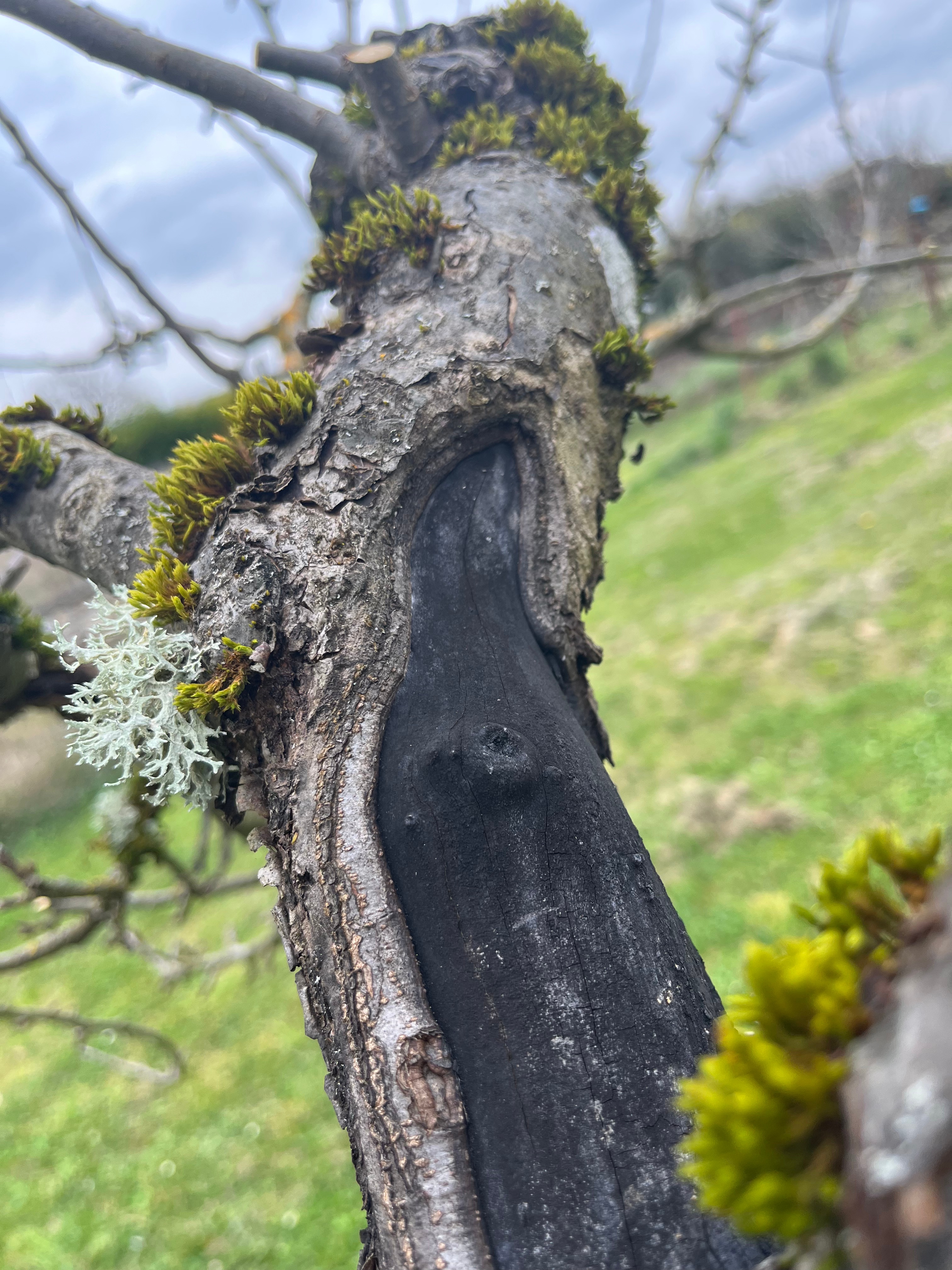
Fire blight or Canker?
“This tree looks as if it got struck by lightening — Look here, right in the crown! Oh there are burns all over it. But the tree looks healthy and it has loads of buds. What caused this? When could this have happened?”

Thanks to the internet, I concluded that this lovely young apple tree has a deadly bacterial infection, Fire blight (Erwinia amylovora). BUT then it was suggested that it looks more like a fungal Apple (Nectria) Canker (Nectria cinnabarina or Nectria galligena), which is less terrible for the tree and the orchard. Once again the internet offers the scariest diagnosis of what ails us. I should know. Although sometimes it is right!
The internet says “prune it out” as soon as you see it, whichever it is, but we just saw it today and I fear it is well beyond pruning out as it is right at the core of the tree. Some websites say if it is Fire blight in a young tree and is in the trunk as this is, the tree should be removed; if it is Canker it can be treated (although I fear with a chemical I won’t much like). Whichever it is, if you want to try to save the tree and contain the infection, the internet advice is to cut away the infected areas and be as ruthless as possible. If it is a canker I can help the other plants by making sure they are healthy and strong; if it is a bacterial infection there’s not a lot I can do.
I’ve been saying “the internet” because when I saw the tree I just did a search for the symptoms and then read everything. Just as we do for that nagging cough!
A more systematic approach while I await a consultation is Cornell University’s “Database of Apple Diseases,” which promises “basic knowledge of the disease cycles and biology through disease factsheets and information on advanced disease diagnostic methods . . . that will not only benefit experienced growers, extension educators and crop consultants, but also small to medium sized or home growers.” The site, which is brother-in-law approved, notes that the necessary “information is fragmented and can be difficult to search,” which was my experience. So for other folks with apple trees, here is a responsible resource. I should add that as a former resident of upstate New York and Ithaca for a while, I was already familiar with Cornell’s AgriTech program, “the oldest apple breeding program in the United States” responsible for over 70 varieties, allegedly including that version of the HoneyCrisp I still dream about [see February 12, 2026].
And here is what I learned: If it is fire blight, curled up brown (dead) leaves stay on the stems. Did they? I don’t know. I wasn’t here in the fall, but if they did, the crazy gale force winds we had in January removed the evidence. The description of Nectria Canker does sound more like what we have, and images on the University of Wisconsin-Madison “Plant Disease Fact Sheet” suggest this is it. I hope so!
One big takeaway here: you can’t be a responsible steward of the land if all you have is the Internet and you do not have basic knowledge of the topic or a guide willing to share their expertise. In addition to the internet, I had books and friends telling me about truffles, but it took Claude and Nadine Blanc walking around the oak trees with us to help us understand the work ahead. And now this. So, this post is really a celebration of expertise (and a request for it)
Here’s a gallery for those who have diagnostic skills. These “burnt areas” (not really burned, there is no soot) are on most main branches, at the heart of the tree, and on the trunk, and also on all of the old prune cut. There are no orange/pink spores that I can see, and no dead leaves or curled twigs. Suggestions in the comments welcome please


