This week I got my first course in orchard management

Last week my agronomist and historic garden curator/manager brother-in-law (my go-to expert on all things that grow in the ground) explained “the plumbing” of trees, how the energy moves to certain buds and shoots and how to facilitate that. We looked at a very sick greengage and he showed me where the tree was isolating the damaged part to allow the sap to move up to the healthy branches. We looked at my roses and, again, he told me where to prune based on where the growth would be. I grew up with roses and learned how to prune them from my mum who in turn learned from her father, but thinking about it in terms of how roses work as biological organisms rather than than just following established rules and principles was quite eye-opening. Prune wisely and aesthetics follow. I see how his students learn from him. I’m reading several books on how trees work, so I expect to write more in future.

Then on Monday, Christine Tressols the garden goddess (and local politician) finally stopped by. I asked her my questions and she answered. (Yes, the bougainvila is dead; too cold for it this winter—we should have bought it inside. No, the olive trees are not dead; it is not unusual for them to drop their leaves in the cold or heavy wind. That is not a fungus on the hedge; it is only on the north side. It’s a lichen and not related to why they are turning yellow. You can test to see if a plant is dead by scratching the bark. If it is green underneath it is alive).

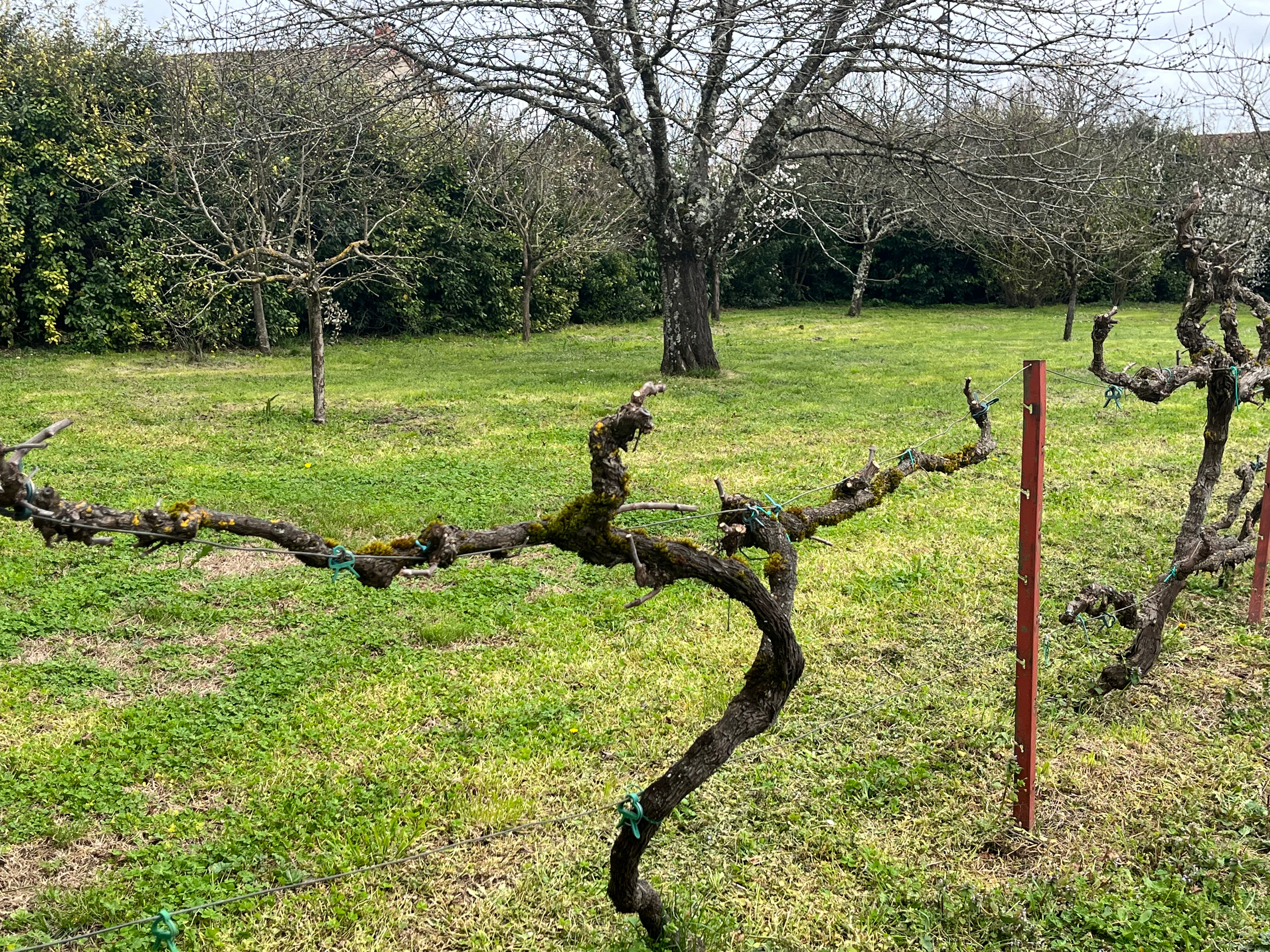
But she also showed me how to prune the grapes correctly. I had read a lot of websites, and had tried [see February 7, 2026], but I had missed the principle at work. It is almost the same as growing roses on a trellis — cut back most of the uprights and all of the shoots in other directions and just keep upward facing shoots at a regular distance (maybe 10 cm for roses, 20 – 30cm for grapes). The difference with grapes is you keep two little shoots outward-facing shoots pointing in the direction of the wires, and you ruthlessly cut away the rest. I had not been ruthless, and had kept lateral branches. No more. “The plant has all it needs to grow right here in the main trunk,” Christine assured me. Now my olives look like the plants in the fields on the way to Gaillac.

But the real joy was the fruit trees. She explained how to take the weight off the branches by removing verticals, how to “open up the crown,” and how to increase the quantity and quality of the yield. I sort of remember how apple trees pruned for maximum productivity should look from my time apple picking for ICI, and my BIL had also carefully explained the principle of opening up the middle, removing crossed branches, taking off the verticals that will take all of the energy away from the end of the branch, and selecting only the most healthy branches and shoots and always going for the one that that faces out. But with the show and tell it all fell into place.

Watching her casually pull out her secateurs and snip as she talked was so helpful. I don’t think of myself as a visual learner, but in this case seeing and then predicting for myself what she would cut was amazing. Placing it in the context of my increasing understanding of trees gives me a taste of what stewarding this property might one day feel like.

Of course, the other trees will be harder. They are older or bigger, or just more complicated. I’m not doing anything to the oldest trees aside from clipping suckers, but the younger trees need help in the old orchard and even more so in the new one by the big field. And now I have a model to look as I work. Today I finished up the grapes following her instructions and made a start with the smaller trees. And I collected a lot of clippings for kindling in the stove or chimnea (a huge pile at the back corner of the front courtyard under the Lindens). Later this week I will tackle the four Mirabelle plums because she says this is not something I can put off to April. It is such a pleasure to be in the orchard surrounded by flowers and bees doing their thing.
Continued . . .
