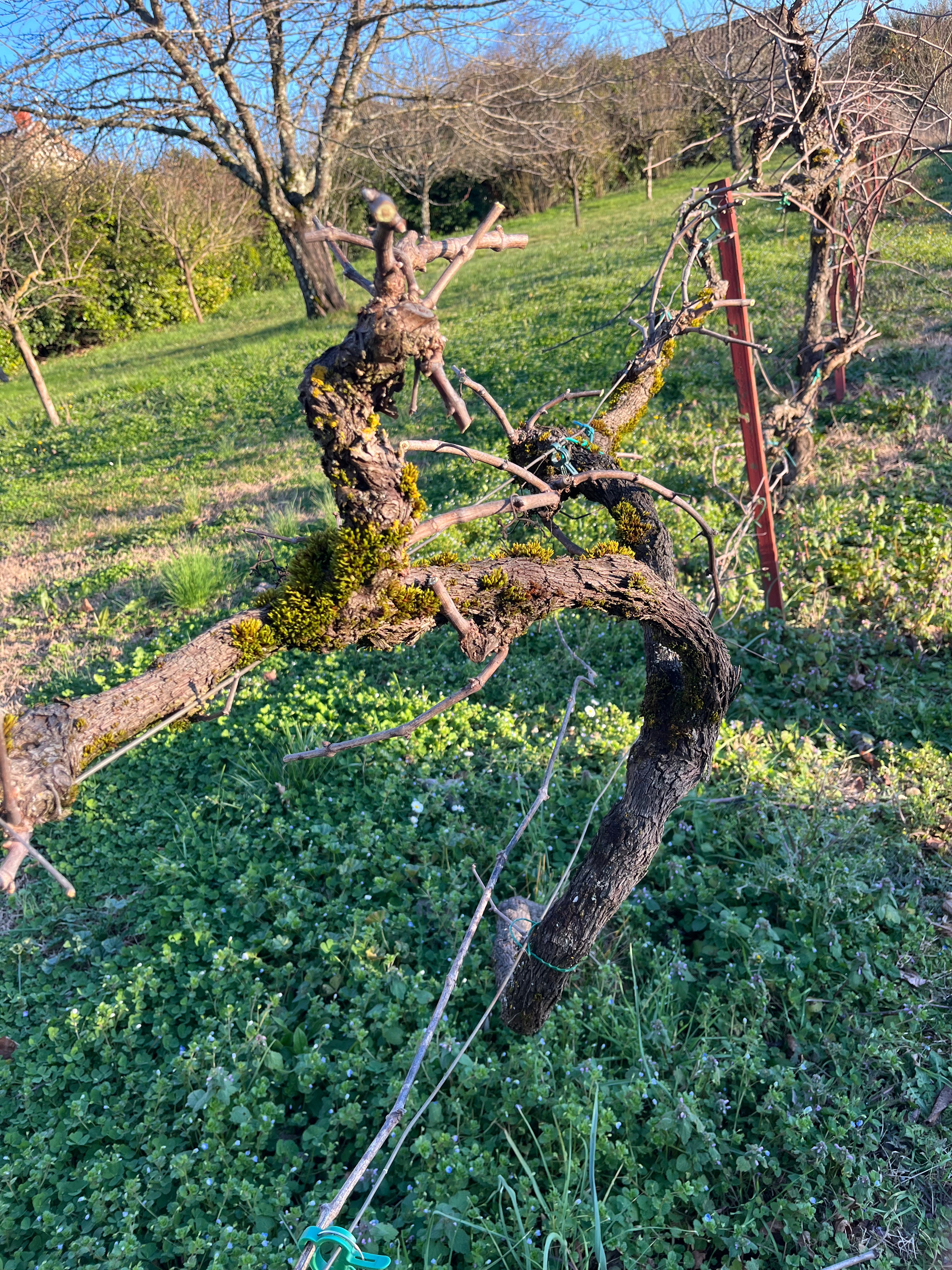
Today felt like spring, so the garden called. And between the showers I decided to tackle the easiest of my land stewardship tasks: grapes.

As I’ve been driving back and forth to Gaillac and Albi this end-of-winter I have been closely observing what is happening in the vineyards that line both roads. Before the snow, I saw people out in the fields pruning and tying and generally doing things to get them ready, leaving tidy rows with brush and weeds cleared. Now the rain is making the rows green, and painful shoots are coming up where the ploughs went through but the dark stems make a beautiful contrast.

One of my deepest pleasures here is driving through field after field of grapes, marching in perfectly ordered rows through far from uniform fields across the landscape, often with rose bushes at the end of the rows to act like canaries in the coal mines whenever any blight threatens. The first time I came here (in 1999) I asked Walter to pull over by the road so I could take pictures of those roses, and now I grow them. Cahors roses. Like the wine! Now I can spend more time here I know that in fall, the leaves turn red and gold. But in winter they are spectacular, marching across the fields like can-can dancers. This year I got to see them in snow and in heavy frost and there was another kind of magic (although I did not get pictures—see January 6, 2026). Last year in many fields the vines were suddenly pulled up and left in piles in the middle of the field. I feared illness, but apparently they were old, under-performing plants in a glut year, and there was government support for pulling them before the harvest. I am happy to see this year a lot of fields with rows of young vines carefully protected in plastic shifts.

We have one long row of grapes, stretching the length of the orchard and espaliered onto two parallel wires with blackberries taking over the far end. We also have a pergola attached to the back of the barn whose roof is grape vines. Three different kinds in all. All table grapes. But our plants are as crazy as an eagles nest. Today was the day to fix that.
The vines in the fields I drive past are trimmed in one of two ways. Back to the central stem with short branches sticking out from the top, or pruned so that one branch (cordon) goes each way along the wires, from which new shoots will grow and from them the grapes. None of them look like birds nests!

One summer when I was an undergrad in England, I got an exchange job picking grapes in Peyriac-de-Mer in southern France. Back then, grapes were harvested by hand, by extended families or hoards of migrant workers, foreign college students, and, where we were an hour from the Spanish boarder, people from Spain. The bushes were nowhere nearly as tidy as these. They were in clearly identified rows, but you had to lift leaves or thrust your hand between criss-crossed branches to get at the grapes (which is how I almost lost a finger). The ultra-tidy rows that grace today’s fields are pruned to facilitate harvesting by machine. But that is not the only reason to prune.
Our plants provide more black, crimson, and white grapes than we can eat. They are all table grapes, sweet and juicy. A burst of incredible taste with a smell to match. Last year, though, they were small, especially the white ones on the pergola. Super sweet, but mostly skin and seeds. “Too much work for nothing” said Andrée. They were also hard to find amongst the thick foliage. Clearly they need work.


The internet (YouTube) told me that they were too small because we let too many canes grow unchecked. Grapes grow on new shoots from last year’s canes, but if there are too many canes the plant has to work too hard to get grapes on all of them and only has the energy to create little grapes. Few canes = bigger grapes.

Christine the garden goddess pruned the long row in spring 2025, but the grapes on the pergola were left to their own devices and chaos reigned. And the row grew bird nests where the tidy canes should have been. The advice was to prune back so each plant put all of its energy onto two branches (cordons), one going each way along the wires just like they do in the vineyards. Pick the strongest branches and prune off all of the others. Leave upright branches from last year’s growth, pruned to only one or two buds. Cut the rest. My problem (well, one of them) is that I have no idea what is last year’s growth. They all look the same color aside from the really old gnarly stems. So who knows how I did, but trial and error is the rule here (maybe that is what we should call the house?). And they look tidy at least!

UPDATE: Christine showed me what I should have been doing. New post coming to show all.

