
In France you can buy a perfectly good basket at the regular market — I got both of my market bags at the Cordes Saturday market and adore them, especially the one with both regular handles and shoulder straps. I felt much more at home when I had my own panier de marché instead of having to borrow Andrée’s. The strappy bag made of palm leaves and leather is apparently typical of Provence, but when we were in Cadaques people had a variant with a fabric liner that zipped at the top and made the perfect beach bag. Most people I see at the markets here have bags like this with no shoulder straps, and more beaten up than mine (which is only 4 years old). They get slouchy, lose their shape a bit, and don’t look so clean. But they last.

The striped basket, also a typical design (perhaps even more common in fact) and also purchased from the Cordes market, is woven straw with a fabric lining and sturdy leather handles. Straw sounds flimsy, but these things also last for decades even though loaded to the brim with heavy vegetables every week. And a little rain or being set down on the wet ground seems to do them no harm at all.
You can buy handmade baskets in stores of course. I got an adorable little rattan basket perfect for small fruits like the Mirabelles, cherries, and grapes at the garden store in Gaillac. I like the simplicity of the two colors, and how shallow it is. It has a high handle which is visually pleasing and handy to hang on a branch leaving you two hands to pick, but the size of the basket itself is what appealed to me. I use it all the time in the summer both to pick fruit and to deliver it to Andrée is manageable quantities.

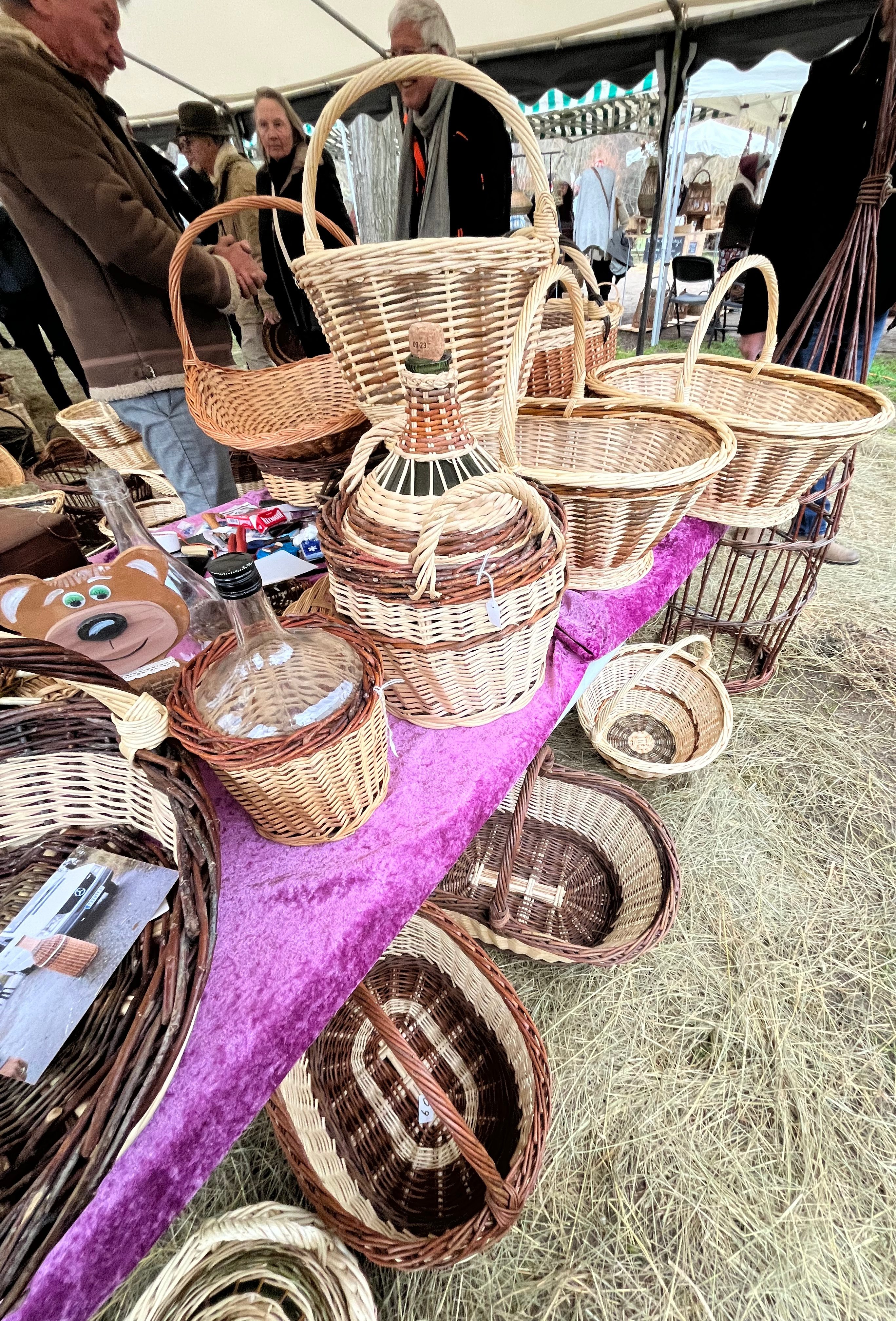
However, if you want an authentic willow basket in any shape, size, and color ranging from the artistic to the functional, and traditional brown or beige to blue and purple, you need to head to Milhars on the river Cérou on a Sunday early in February (this year it was yesterday) when they have cut new stems from the many willows along the river bank and nearby and raw materials are plenty. You can see the pollarded trees in the picture to the right and the smaller coppiced bushes of the river bank park below. Milhars is only about 8 minutes drive from us (on the road to Saint-Antonin-Noble-Val), so I was eager to take a look and watch the basket-makers at work. The day dawned chilly and damp with the heaviness that usually precedes a storm, but I am glad I went (and the weather held).

After walking around for quite a while I broke down and bought a fascinating little woven paper basket made from the pages of Michelin map books. I almost bought the one that was mostly blue — “that is the pages around the coast” he explained — but the regular maps were more interesting (zoom in to this picture to see them properly). In ten years time there will be no map books; already I imagine few people use paper maps anymore, so this seemed an appropriate recycling and memory project.

There was a huge variety in shape, size, and structure of the baskets with some basket-makers, like the one to the left, making more traditional and “useful” baskets, plate holders, and trays, and others showing more whimsey and making things more suitable for decoration than use (see the gallery below). I was on the look out for an interesting basket that we could put near the door for the random important papers, guide books, and maps that we both might need to find easily (yes, we still have paper maps), and I found it.

I liked the wide-mouthed baskets with simple horizontal stripes of light and dark willow, but in the end I fell for the basket on the right, which, as you can see, is exactly the right size. I like the five different colored stripes and the cutaway at the side. Most of it is blue and purple basket willow with two shades of the usual brown basket willow (there are actually hundreds of colors). And the lovely wooden handle woven in at the top adds whimsy and dissuades the cat from climbing in to the basket!

An added bonus is that it was made by one of only two female-presenting basket-makers in the whole place. She told me that the red row is not willow, but made from “something that grows by the side of the road” (I couldn’t work out what it would be in English, but promised to look for red plants as I drove home [update: red osier dogwood — we actually have some growing at the edge of the paddock]). Unlike some of the other vendors, she did not have a fancy card listing her website or online store, just a handwritten sign advertising “un brin de passage” wickerwork and wood baskets, with her name, email, and phone number, but when I asked her if I could take a picture of the artist she beamed. She wished the basket a good life as she gave it to me.


I have always loved baskets and would find a use for many of those pictured below if I could afford to buy them (prices averaged from €35 to €150 with the larger ones over €200 — a fair price but too much for me). I was very tempted by the bird houses, but need to do some research about opening sizes and general requirements before I buy one; some looked to be more for the human eye than the bird. Maybe I will have less willpower at the 18th year of the fête in 2027. It runs all day and there were several food vendors including the sushi guy who comes to the Cordes market, a busy sausage and fries tent, and a third with really good dhal, rice, and tempeh. Milhars is an interesting village in general, complete with castle, lots of walls, and a good café in addition to the river and some posted hikes.


