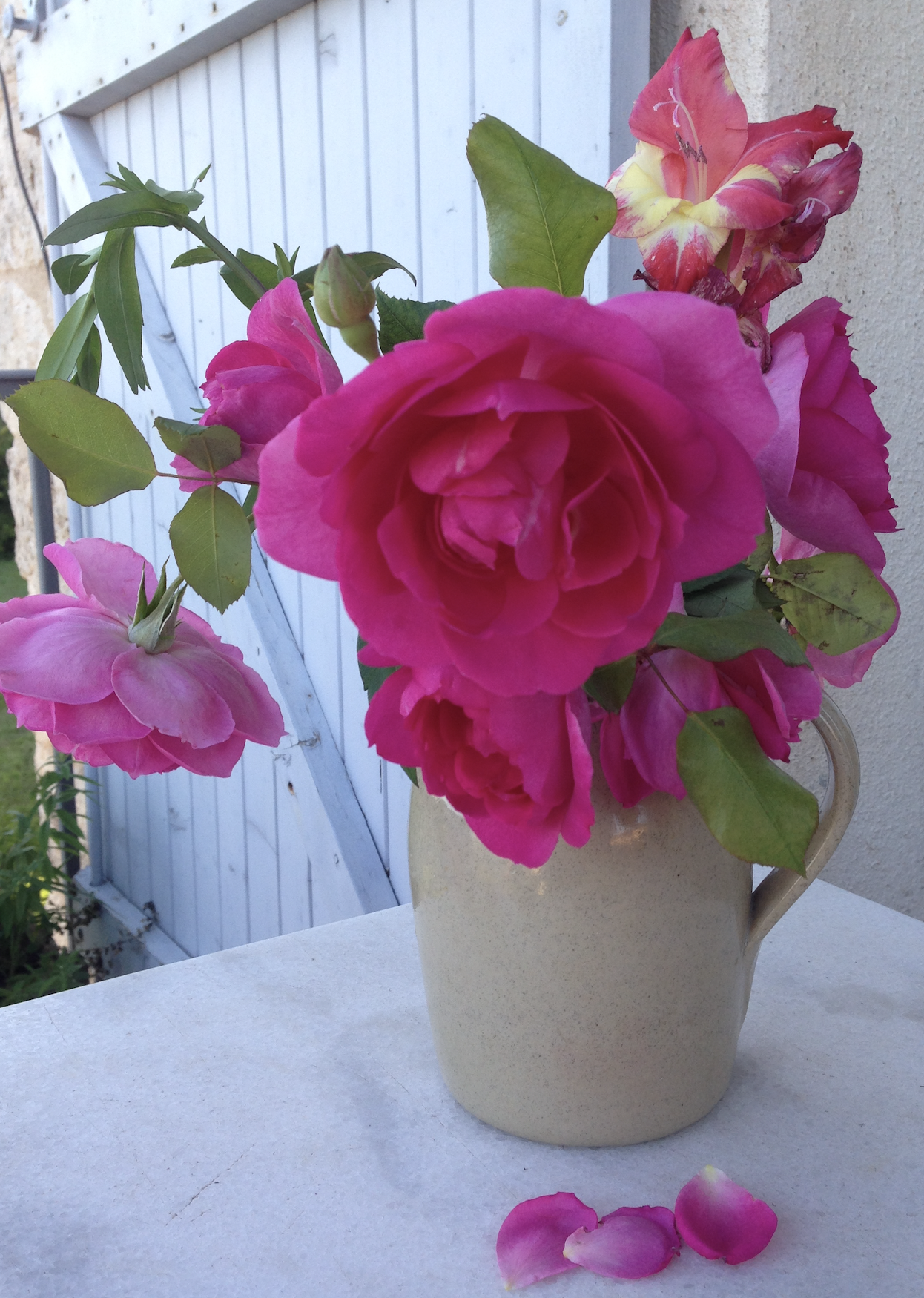

I have always grown roses. My mum grew them when I was a child, and then I have found an excuse (and a place) to plant them almost everywhere I have lived, although they did not always survive. I tried to grow miniature roses in pots, but they immediately slipped into a slow, free-falling, kind of death that made me never want to do that again (although perhaps the lesson should have been to not buy from supermarkets…).
I have rarely been able to bring myself to buy the super expensive roses from garden stores, which means I am forced to nurture and care for sickly little things. I even bought bare roots from E.Leclerc this year. They were in a bundle of 6 for about €5. I think two of them may have survived (but one of them is a deep red pictured at the bottom of this post).
In short, I am a practical flower gardener not a “best of show” type gardener. I love it when my garden looks great and it gives me great joy to see things bloom and to watch the bees enjoying them as much as me, but I do not spend a lot of money on plants and while I like to show off my vegetables, the flowers speak for themselves … or not. I try to know the varieties of things I plant, but I mostly lose the tags within a few years. The one exception is English roses, which I love and which I was delighted to find already growing in front of the house in France. The one person who loves flowers more than me is Andrée, and this spring and summer I was happy to be able to bring flowers to her house long after her roses had stopped flowering. (I need to remember to deadhead hers next year the way I do mine. I don’t want to step on the toes of Christine, who manages her garden, but it really makes a difference with repeat bloomers.)
David Austin Roses


When we lived in North Plainfield (NJ), I planted David Austen roses, which I completely adore (and I managed to find them in France, too). I bought David Austen ‘s “Golden Celebration” when I got tenure. A gorgeous English shrub rose with complex, heavenly scent and big flowers. I used to say that I could just sit under that bush and smell it forever (and I did put a chair there). Typical of the variety, the flowers are big with a tight ball of petals that when they are slightly less mature than the ones in the pictures look like little cabbages.

I also planted an Austin “Heritage” variety, which has an even more wonderful scent, a little sweeter than Golden Celebration, but almost other-worldly. Indeed, I forgave it for being pink because of the scent. That said, mine was a very delicate pink even paler than the image here, fading from shell in the center to almost off-white petals at the edges. I had four other English roses in that bed.

One other was pink, but it was Gertrude Jekyll (named after the gardener) and had such a classic rose scent that I couldn’t resist. The petals swirl around each other (the website says “scrolled buds” and “rosette” flowers). They always made me wish I had the skill to paint them. I planted another yellow (Vanessa Bell, a pale yellow that did not do too well but did give me a few lovely flowers) and a couple of whites that I can’t find on the website, so may not have been Austins.
That was the first dedicated rose garden I planted, hence the nostalgia. Sadly they were eventually cast into shade by a volunteer tulip poplar that we couldn’t bring ourselves the cut, and the developer who bought the house after the fire cut down every tree, shrub, hedge, and flower on the property aside from two dogwoods. The roses would have needed some TLC, but the huge magnolia at the side of the house was the final straw for me. Don’t look back!
Housing complex roses

The apartment complex we moved to in Madison after the fire has an impressive array of plantings, a left-over from when it was owned by the University and tended by our grounds people. What were small bushes when I lived there in 1993 are small trees now and they have planted the understory with oak leaf hydrangea, hosta, astilbe, and flowering ground cover, and this year, they planted roses where there was no shade.

The hydrangea are a little big for the handkerchief-sized plots in front of our doors and the huge cone shaped flowers fall all over and in some cases block the path. But I was delighted to see roses appear at the sunny end of my block last year, and then in front of my flat in the tiny pool of sun where I used to put a chair. I am happy to exchange occasional sun-sitting and tree-bathing for roses! I took to pruning the dead flower heads to extend the show (and give them a bit of shape). But they are still small and the bushes scrawny. I do miss the proliferation of climbing and English roses I enjoyed in England and now in France, too.
David Austin and old garden roses in France

I wandered into Gamm Vert one day and there in front of me was an unmistakable David Austin, Olivia Rose Austin. It is a bit too pink, but a delicate pink and I guess I need to accept that a lot of roses are pink. Indeed, most of the roses around the house in France are pink, and while I am trying to root cuttings from the lovely yellow and peach roses that grow up Andrée’s walls it is a slow process [see April 6, 2026 — I think only one of these made it through the brutal summer, although I did not risk disturbing the roots in August!]. Austins are expensive in France, and I didn’t see any for sale this year so I can hold out for another Golden Celebration or a Vanessa Bell, which is also lemony and just a lovely shade. I like the idea of roses named after authors and characters, but given Andrée’s devotion to family, I love that Olivia Rose is named after David Austin’s granddaughter. I mistakenly planted it to close to the Linden canopy and in high summer it is shaded for part of the day, so will never reach English rose bushiness, but it seems to be holding on and was very prolific in the spring. It makes me happy each time I walk to the car.

Apparently our house’s owner before last who did most of the renovations also knew a thing or two about roses. A friend of his who lives nearby said there were beautiful roses all along the front courtyard side of the pigeonnier. He said he took cuttings and when I am ready I can go and root some. I’m practicing rooting Andrée’s roses first. Hopefully he has a picture of what it looked like. I’d love to restore it, or combine our two garden designs. The roses that have survived years of weeds and neglect are what I would call “Old Garden” although that includes multiple things. Sharon Santoni calls them “Old French Roses” (her blog “My French Country Home” contains lovely, lush photographs of her roses and we seem to agree that you can’t have too many). Whatever they are called, I managed to salvage two of what I assume are those climbing roses, one away from the wall (left) and one at the base of it. Yes. Both pink. They need a lot of TLC having been submerged under weeds, giant acanthus, and a very prolific Russian Sage. There is also a huge pale pink rose next to the wall by the vegetable garden that I assume went in the same time. This year it was amazingly healthy and the more I cut the long canes it put out, the more flowers it produced (and more canes) –see the picture of the bouquet at the top of the page. I’ll try to find out the names of these.
So many pink roses!


In the patio there are two huge rose bushes between the stone sink and the back door. One white and the other, yes, pink — this one a deeper shade than the three out front. When I arrived they had missed their fall prune back and they were lolling all over the patio in a blaze of rose chaos. The canes were pretty matted and they still need one more prune back to sort them out. Hopefully it won’t rain all the time when I go for Fall break. The white has classic tight buds on upright stems like the ones sold in flower stores as long stem. And when pruned right they frame and peek inside the kitchen window (when left, they cover it). The pink, which drapes itself over the stone sink, is closer to wild in some places, but it is a classic mid-pink and amazingly prolific. Somewhat surprisingly, the two roses compliment each other, even though they are totally different in everything aside from their hardiness and almost constant blooming.


.
And the last of the inherited roses is on the wall outside the studio just beyond the patio wall. It spent the summer fighting with the bamboo to colonize the whole wall, and by the end of the summer it was growing up over onto the patio — something I plan to encourage, although carefully. We planted honeysuckle on the other side, a housewarming gift from Mariannick, so together these should soften the edges of the courtyard and, with the lavender along the outside of the wall, provide a little scent as well as color. We put up a trellis to keep the entrance open because the rose gets so bushy so fast, and I was afraid it would lose something visually if not unruly; however, I don’t think it did (apparently I have no picture of the whole thing).
Finally, a hedge of reds, mostly Cahors

My ongoing project, started with my sister the first time her family came in 2025 when we began the process of planting a hedge of roses and lavender between the “road” separating the lawn behind the house and the olive grove fence — a total of 32 yards (29meters) in all. The studio half of that border is lavender, and the patio half is roses extending as far as the vegetable garden. Rather ambitious as it turns out, although the lavender is probably only two years away from glory. The roses are harder, partly because they are so soundly neglected. I wanted them all to be Cahors, the roses traditionally planted at the end of rows of grapes to warn of infection. You can’t get tougher than that. No water. No fancy fertilizers. No bug sprays. Now that is my kind of rose. And a bright, cheerful red. Red! I planted a few next to the gate among the lavender, but like the David Austin they are too much in the shade in summer and this year barely limped through, even with food and water. The ones in the new bed get sun and, sometimes, water, but I think they didn’t like being frozen in January. Two of the not Cahors seem to have died off leaving a non-flowering “rose” growing from the grafting root. The others mostly managed to produce a few flowers, and one pretty hardy mystery rose that might be a climber produced a deep, nourishing, red rose (below) not not exactly the hedge I was picturing. But gardening is patience. I know.


Next year my new venture is going to be flowers in among the bushes in front of the house. Watch out world!