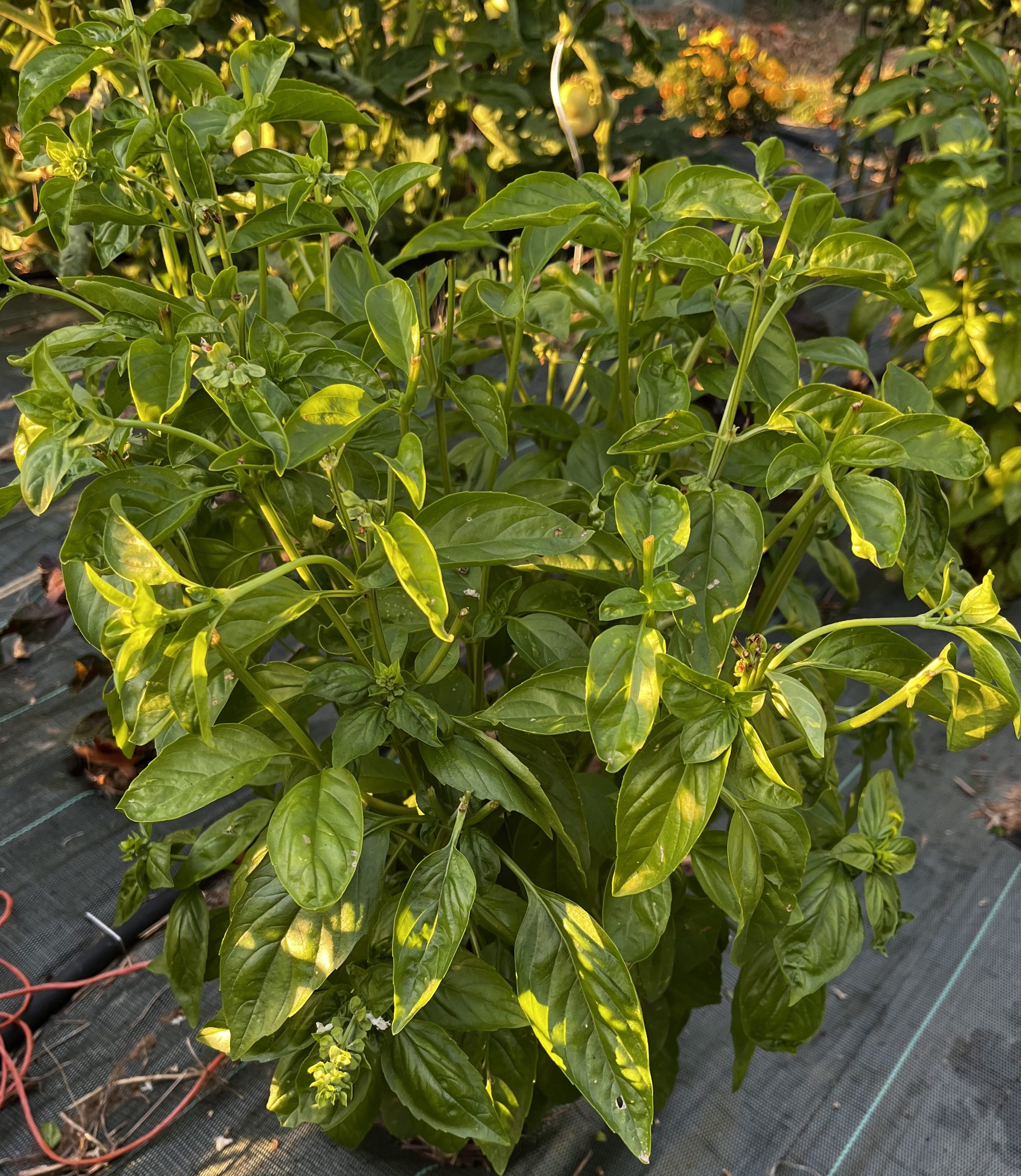

Since I arrived in the US, basil is the one thing I always grow, even if it is in pots made from decapitated gallon jugs as I did in graduate school. In the States, the supermarkets sell pots of “living herbs” to be used and discarded. Or they can be planted out, but obviously that is not the idea. Many of them advertise themselves as organic, including the basil, which also tends to be 10-12 plants all crunched in together to look like one plant. For a few dollars. Soak the root ball in a bucket of water and gently separate, and you have 6-8 plants for the price of one. Although a grad school trick, I continue to do it (so much cheaper than buying a half-a-dozen plants and easier than growing from seed). So when I saw the same pots of organic basil here I jumped at the opportunity. I now have 9 thigh high basil plants in the kitchen garden, interspersed with the tomatoes and peppers. And they are ready to flower.

I cut off the buds last week and made basil dipping oil by steeping them in good olive oil and then straining. The chopped basil and flowers made a marinade, which was great on a piece of salmon.

I love to eat basil wrapped around baby tomatoes picked sun-warm, or with tomato and goat cheese with a drizzle of balsamic; I chop it up in marinades, sprinkle it on rice or pasta with a splash of olive oil and some black pepper, or add it to salad dressings. It is good in cocktails as well, and I have seen recipes for jams with basil. But most of all I love it in pesto. I eat pesto tossed into pasta of course, but also as a coating on seafood (especially grilled or broiled white fish, salmon, shrimp, and scampi), on roasted root vegetables, slathered on super fresh bread, or just on a spoon. I could eat it everyday, and in summer I often do. First we have the asparagus that needs to be consumed daily as it arrives, then a month later we start to have pesto. What is uneaten freezes really well if you hold off from adding the cheese before freezing and just add that and a few spoonfuls of pasta water when you defrost and serve.

This week the bud-flower situation was out of control again, so I engaged in a serious trim of the tops down to the leaf joint below the flower. Françoise says I can do this 4 times per plant and then it will just stop regrowing. That’s a lot of pesto! From my trim tonight I got 15 cups. Which turned into one pot for us to eat now and five to freeze (each with pesto enough to make pasta for four or five. I usually freeze it in ice cube trays and then pop the cubes into ziplock bags, using the old “one cube per person and one for luck” model to serve, but this time I didn’t have any so I used plastic boxes with a thin layer of olive oil on top to keep the air away). We can get two pasta & pesto meals or one pasta and some basil shrimp from the pesto I did not freeze, which will keep us going until next week. The haul was 50% flowers so did not process down to a lot of pesto. The next harvest should make more.
The power of a recipe
But as much as this post is an homage to pesto, it is really an homage to friends and the power of shared recipes and the memories carried in flavor combinations. As I said, I started growing basil when I was in graduate school, which is where I got my pesto recipe. When I arrived in the MA program at Binghamton, insecure and older than most of my peers, there were a few women my age or older already in the doctoral program who I admired tremendously. I was surprised and delighted when they included me in their circle, and we had several adventures in addition to serious work. On the serious work end, frustrated with the Anglo-American feminism that dominated our coursework, we formed a Marxist-Feminist reading group under the leadership of Giovanna Covi, already a scholar in her own right. We met weekly, read deeply, and expanded our thinking to include the intersections of Marxist and French feminism with post-colonial and global south studies; the impact of race and sexuality; and the broader ecofeminism of the time! It was 1980s exhilarating and we presented our thoughts on a panel at a conference at SUNY StonyBrook (my first conference presentation). Their mentorship and friendship gave me confidence and opened so many intellectual doors as I discovered literary and critical theory.
They also included me on a trip that became a little islands of memory of a perfect day. We visited a friend of Giovanna’s in Pennsylvania. Like Giovanna, she was Italian and I assume they knew each other from home, but they could have met in the US. Marvi lived deep in Amish country, I’m not sure that we saw a car for quite a distance. She was an artist and potter and I bought a covered butter dish and Winnie-the-Pooh style honey pot from her little store. The glaze is really interesting. They look plain but the more you look the more levels of color you see. The cover of the butter dish was dropped by a careless housemate years ago, but I still have the honey pot after 40 years and many moves.

It was summer and we ate pasta with pesto. I think we ate outside, I remember the temperature being perfect and the sunlight dappled. I think it was late June with the first basil harvest. It was probably the first time I ever ate pesto, so that recipe is in my head as a template for exactly how pesto should taste. I don’t remember if we made it together or if it just appeared, but the taste stayed with me and I hounded Giovanna to get the recipe for me. She did. And the notecard on which I messily scribbled Marvi’s pesto recipe has been stuck to my fridge everywhere I have lived since then. Now it is on our fridge in South West France, a coming home of sorts. And yesterday I made the pesto, which was every bit as good as it ever was. I recommend it!
In memoriam
In preparing to write this post I wondered whatever had happened to Giovanna. The last I had heard she was still teaching in Italy at the University of Trento, but as she was a few years older than me I wondered whether she had retired. I couldn’t imagine her ever not teaching, writing, speaking, and doing her anti-discrimination/anti-violence work. Instead of her latest work, though, my search turned up her obituary. If you do not read Italian, here is DeepL’s translation which captures the main points if not the language of the original (I hope you can access this or just translate ityourself):
Marchi, Lisa. “Giovanna Covi (1952 – 2023). In Memoriam.” RSA Journal, Rivista di Studi Americani Vol. 36 (2025): Vol. 36 (2025): Reproductive Justice and Its Discontents: Recent Representations in American Popular Culture. https://doi.org/10.13135/1592-4467/12468.
Several other significant women from my graduate school days are no longer alive, including Anne Higginbottom (whose obituary I am unable to open) and Lori Ambacher who was my housemate, and younger. It is certainly sobering. So today, I dedicate Marvi’s pesto to the women who shape our lives in ways we only realize in retrospect, and in this case, those who introduced me to pesto, to an expansive and inclusive, intersectional Marxist-Feminism, to serious thinking, and to the power of an intellectual life that includes tooling around the countryside looking for a hidden house full of pottery and pesto. So many threads and chance encounters shape who we are, and I love that a recipe takes me back to the start of this one.

.