This is a story about my kitchen garden, but it begins with my first attempt to garden here, and my sister.
My sister visited a year ago at the beginning of the first part of my gardening frenzy: roses and lavender. I planted what I still imagine one day will be a lush border of lavender along the fence by the olive grove opposite the studios, with a hedge of red Cahor roses opposite the covered patio and hammocks. We planted most of those in the very early morning before it got too hot. Including 24 lavender plants we got from Aldi for €2.50 for 8 very tiny plants—a fraction of the garden store price. They are compact plants with deep blue-purple flowers that bloom weeks before the others. I love them, but I have seen them nowhere else since that Aldi’s visit. The rest of the border is the typical long stemmed variety, some with white flowers and some with lilac. But all are mostly untroubled by weeds.
This really is a story about weed mesh

My sister encouraged me to put it down to control the weeds that a year before had choked half of the roses I planted.

We went to Gamm Vert and RAGT and stocked up on the narrowest weed mesh we could find (1m), which we cut down the middle to make two narrower strips. The metal pegs were long and half of them were bent or distorted by the stones, but we persisted. In all, 32 yards (29meters) of beds, 2 feet wide, pegged, planted, lined with gravel, and covered with bark mulch. [Read the story on my March 20, 2026 post].
It looked lovely and I am still delighted, both by the appearance (although it is not this neat any more), and by the survival of the plants (only three lavender and two roses are no longer alive), but my delight is mostly because my sister could be my planting (and weeding, and garden store) buddy. She was still in high school when I left home and we finished growing up many miles apart, but like our mum and grandfathers on both sides, we both love messing around in the garden. At her house, she has created an amazing vegetable and flower garden with poly a tunnel and raised beds with luscious plants and fabulous veggies (I can still taste those baby new potatoes).
And she did it with the help of weed mesh


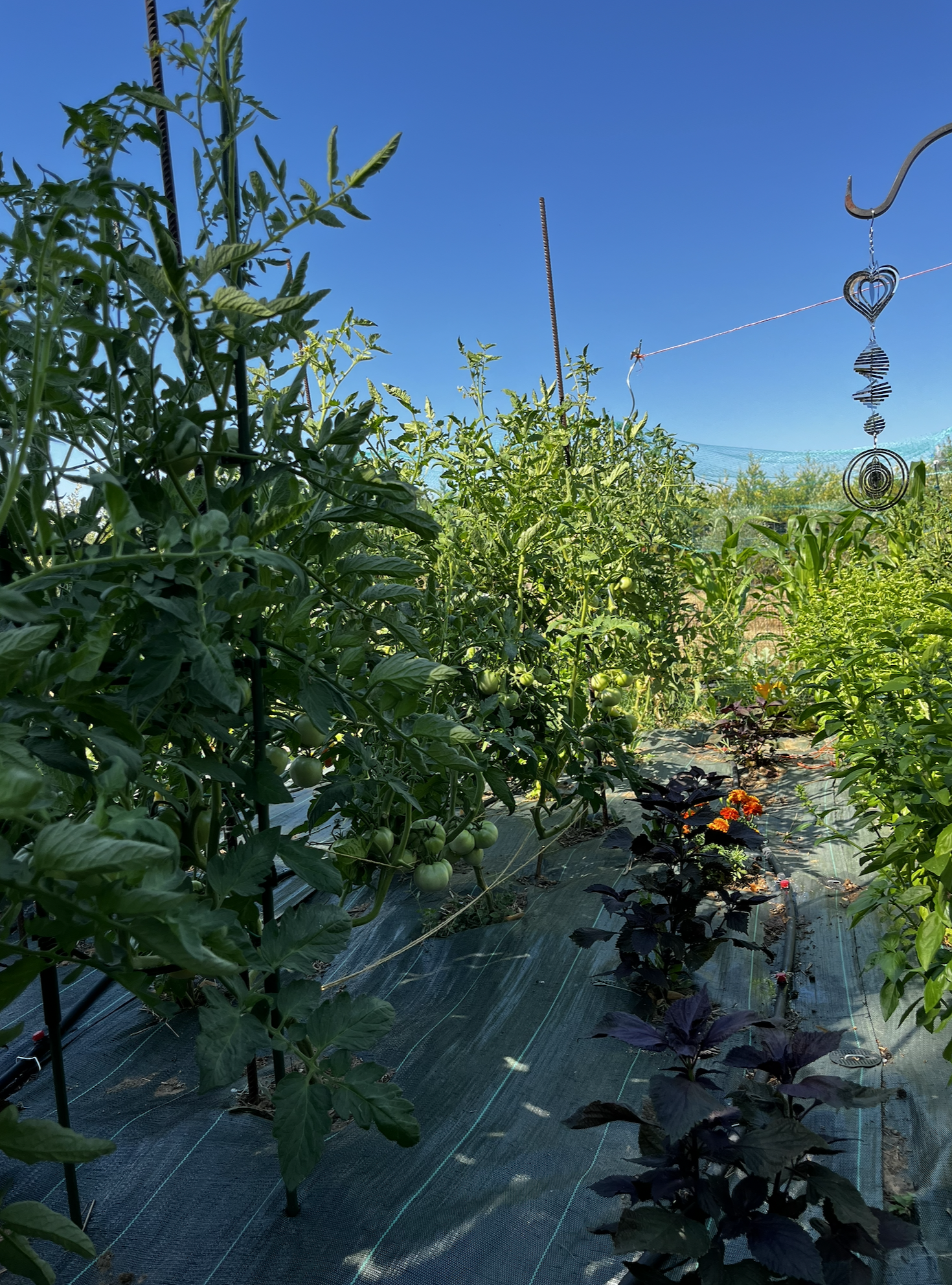
So she was a great mentor on my projects, and needless to say I became a fan of mesh/membrane as well and bought large sheets of it when I set about making my kitchen garden. I was intending to put cardboard down to try to smother the weeds that had taken over, or just a lot of mulch, but my experience with the lavender/roses made me go with mesh. When I sent the picture of the garden from my June 17 blog post (above) to my family, my sister’s first comment was “I’m loving all that weed mesh!” Me too.

But it was a lot of plastic and when the plants were small it looked pretty ugly to be honest, especially because I didn’t mulch on the top, make raised beds, or build elegant trellises. Soil. Mesh. Plant. Repeat. In tidy rows by plant type and variety like my grandfathers before me. I liked no weeds, but I love the look of weed free soil. But this year is the experiments year. What grows and what doesn’t? What shall I grow again? What staking methods work best? And so on. So, meed mesh. I set up the same drip hoses we inherited in the olive grove, and that was the second lucky decision. There are 4 hoses, but only enough water pressure for two at a time, so watering is a process of remembering on and off times, just as it is with the olives (where I can only water one row or 10 olive trees at a time).
One thing my sister probably doesn’t have to worry about is an absence of rain — although we are not the only place feeling the impact of climate change this summer. But the mesh and drip method turns out to be really smart in South West France in the face of rising temperatures and early canicules. It hasn’t rained since May 14, so the plants are grateful for any fluid they can get. The mesh lowers the soil temperature up to 10ºF, and drip watering delivers the water to the roots and can lower soil temperature by a further 10ªF, meaning that in a canicule, vegetables planted with mesh and drip hoses have an edge on those just stuck into the ground. And this year that edge was crucial. I invested in a soil moisture measure and 24 hours after watering, the soil below the mesh (and shade cover — see next post) is still sufficiently damp. My poor melons planted directly into the ground in a small mound of soil in the pie garden are bone dry every day.

Meanwhile, many experienced gardeners around us are looking at stunted tomato plants with fried leaves, flowers falling off, and little or no fruit. I was lucky that mine fruited before the first heat wave and the mesh regulated the soil temperature and moisture, but I give my sister all credit for that innovation (see my last post).

Now only one variety of my tomatoes is ripening at all (Andine Cornue), and that slowly. That row is the one that gets the least late afternoon sun, and the one furthest from any color is the row that gets the most afternoon sun. They are different varieties, but the difference is duly noted.
The Andine Cornue tomatoes were very tasty with a nice texture and delicate skin — and a cool shape. Today we harvested all 6 of them (one from each plant). First, Charlotte came by looking for tomatoes for Andrée, so we gave her three and had the rest of the ripe ones at lunch. I also gave the first crop of baby yellow pear tomatoes to Yvon, who says he has given up on his crop. In reality, I may need to pick all those green tomatoes and hope they ripen inside. But that is a LOT of green tomatoes. Time to explore alternatives.
The reality of gardening

As I learned from the olives and artichoke experiences, when things suddenly die I shouldn’t automatically blame myself, especially if it follows an extreme weather incident. As time passed we have talked to more and more people who lost at least some of their artichokes, although like mine, I hope their leaves are coming back revealing that the roots survived (and I am giving them some water to help them reestablish). Similarly, lots of people woke up to leafless olive trees one morning, or witnessed some rapid leaf drop at least. And like mine, while a lot of branches and twigs are dead at the ends, they are putting out new leaves closer to the trunk. Mine were covered in flowers in March, but then they weren’t. I think the heavy winds and rain knocked them off, but maybe the trees could not sustain fruit and regrowth simultaneously. Eight of the 29 plants have at least a few olives which is more than I expected, but all have leaves and seem to be coming back from the freeze [see January 5 & January 6]. They are not dead and they seem to be coming back to health. If slowly.
Aside from the stressed tomatoes and peppers that never grew tall enough, the garden is great and the mesh is a miracle. The roots of the corn are sufficiently moist to allow it to grow tall and full of tassels, the basil is almost waist high, and the squash are rapidly taking over all available ground. And there are almost no weeds. Though I say it myself, the garden does look pretty good.
But if I can’t blame myself for the olives and artichokes, I also can’t take credit when good luck brings garden success and the suggestion that I use weed mesh was certainly a lucky one. The result is that I have an impressive garden that Walter has been proud to show off.
I’d like to take credit for that, but it was the mesh.
Thanks sis.
